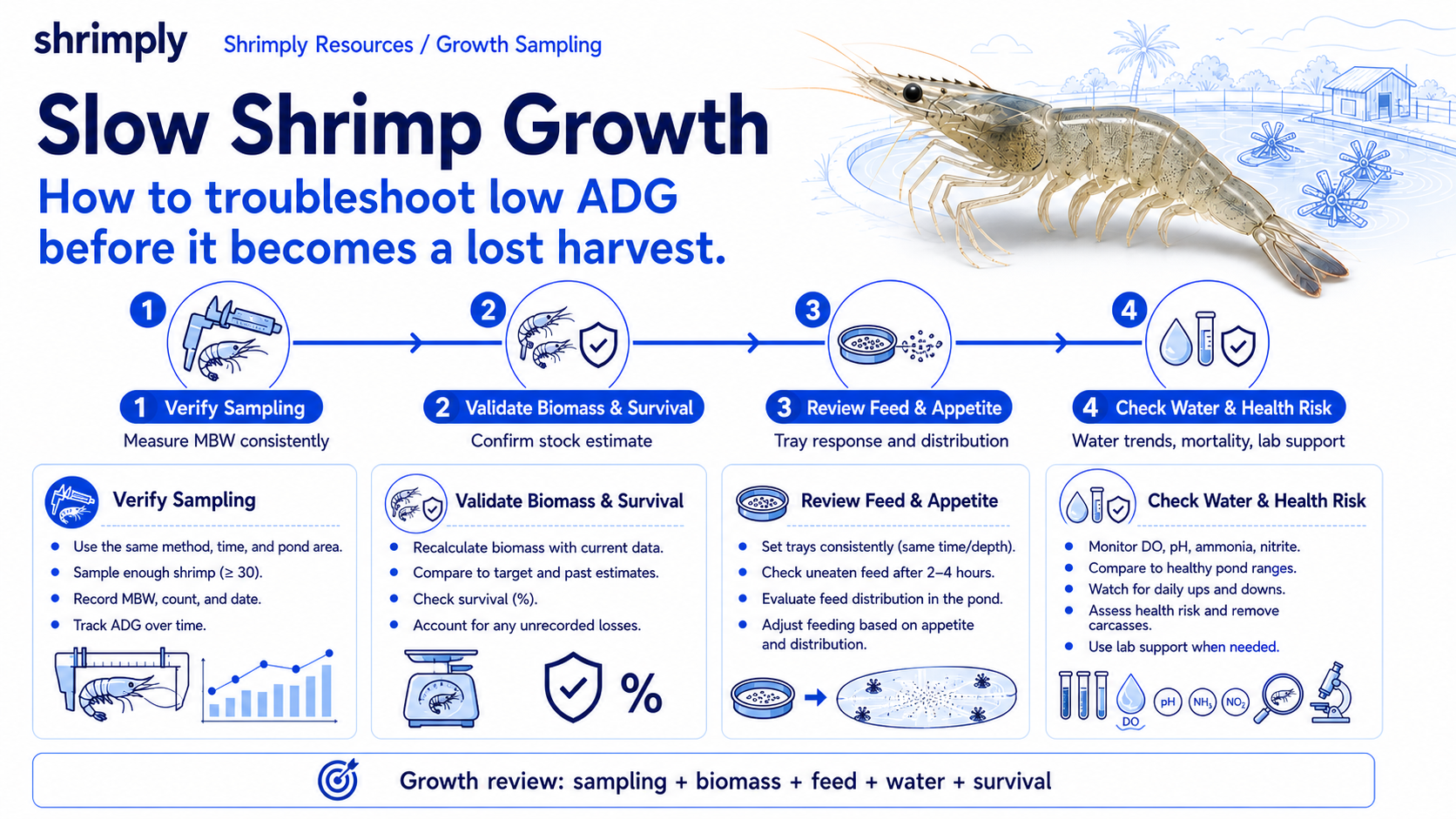
Slow growth is a warning signal—act before feed becomes waste
Slow growth is not one problem with one cure. It is a warning that the pond is not converting feed, water conditions, and stock potential into expected weight gain. Treat it as a pattern when MBW or ADG repeatedly misses the farm's crop plan, size variation increases, or feed use rises without matching biomass gain.
Do not automatically increase feed. First confirm the data, then identify what is limiting growth. There is no universal ADG target that fits every vannamei farm: density, pond system, season, salinity, feed, aeration, disease pressure, and target harvest size all affect what is realistic.
Step 1: Confirm that growth is genuinely slow
Calculate average daily growth as: ADG = (latest MBW − previous MBW) / days between samplings. Compare two or more consistent samplings and record DOC, sample count, sampling area, MBW, size variation, feed issued, mortality, and recent water-quality readings.
One low sample does not always mean a growth problem. If MBW and ADG remain weak over comparable samplings, treat it as a real pond-performance issue. If one reliable sampling is missing or uncertain, label it as uncertain and schedule the next sampling before making a major feed or harvest decision.
Step 2: Read clean trays correctly
A clean tray means feed was removed from that tray. It does not prove that shrimp are growing well, that the ration is correct, or that the pond needs more feed. If trays are consistently clean but MBW is flat, first verify whether actual survival and biomass are higher than estimated. Underestimating shrimp numbers can leave the pond underfed per unit of biomass, so trays may clear quickly while individual growth slows.
Then review feed distribution across the full pond, tray placement, shrimp gut fullness and condition, size variation, water-quality trends, mortality, and health-risk signs. If trays have leftovers, appetite is weak, or shrimp are inactive, do not increase feed. Hold or adjust the ration gradually under the farm SOP while checking water quality and health.
Step 3: Correct water conditions before pushing feed
Water stress can reduce appetite and growth before a visible crisis occurs. Review the recent trend for dissolved oxygen, pH, temperature, salinity, ammonia, and nitrite—not a single reading. If oxygen is falling or appetite drops, inspect aerators, check for dead zones, organic load, algae changes, and recent feed increases. Do not increase feed until appetite and water stability recover.
If ammonia or nitrite is rising, stop ration increases, reduce avoidable feed waste, and review pond-bottom condition, aeration, and the farm's approved water-management procedure. Recheck readings after corrective action. Fixing the pond environment is often more important than changing the feed table.
Step 4: Recalculate survival and biomass
Feed decisions should be based on actual biomass, not only the original stocking plan. Review mortality, cast-net observations, sample counts, and shrimp condition. If survival has been underestimated, the pond may have more shrimp competing for the same ration than expected. If mortality has been missed, the farm may be overestimating biomass and issuing too much feed.
Update estimated population and biomass before setting the next feed plan. When biomass is lower or higher than expected, do not change feed automatically: first confirm how many shrimp remain, whether they are eating, and whether pond conditions can support growth.
Step 5: Rule out health problems without guessing
Persistent slow growth, uneven size, poor FCR, pale or empty gut, weak appetite, soft shell, white feces, or chronic mortality may point to a health issue as well as a feed or water problem. Slow growth alone cannot diagnose EHP, WFD, Vibrio-related disease, or another condition.
Record the pattern by pond and DOC, control movement of nets, boots, tools, water, sludge, and staff between suspect and unaffected ponds, and seek appropriate laboratory or veterinary support when the pattern persists. Do not use medication as a substitute for evidence, water stability, or a controlled response plan.
A practical 48-hour response plan
Today: validate MBW, ADG, sample method, and sample count; check feed trays, shrimp behaviour, mortality, and aeration; record water-quality readings and weather; and do not increase feed until the pond review is complete.
Tomorrow: compare the last three to five sampling, water-quality, appetite, feed, and mortality records; identify the clearest operational issue; and correct it gradually while documenting the action. At the next sampling, recalculate MBW, ADG, survival, biomass, and FCR. If growth remains weak or health signs increase, escalate diagnostics rather than repeating unproven actions.
Confirm recovery with records
A pond has not recovered just because trays are clean or water looks better for one day. Confirm recovery through improved appetite, stable water trends, realistic mortality records, and better MBW and ADG at the next comparable sampling.
Shrimply helps the team connect sampling, feed logs, water trends, mortality, disease notes, and harvest planning in one pond record—so the farm can see whether an action actually improved growth.
What to apply on the farm
- Confirm MBW, sample count, sample method, and days between samplings before acting on ADG.
- Validate survival and biomass before increasing feed when trays are clean but MBW is flat.
- Review feed distribution, tray placement, shrimp condition, water trends, mortality, and size variation together.
- Do not increase feed into weak appetite or unstable water.
- Correct the clearest operational issue gradually and document the action.
- Escalate persistent slow growth or abnormal signs through the farm's biosecurity, diagnostic, and veterinary process.
Why are my shrimp growing slowly?
Slow growth can be associated with inconsistent sampling, inaccurate biomass or survival estimates, feed distribution, weak appetite, water-quality stress, crowding, weather changes, and health problems such as EHP. Review the full pond pattern before assuming a single cause.
How do I calculate ADG in shrimp farming?
ADG is the change in average body weight divided by the days between two comparable samplings: ADG = (latest MBW − previous MBW) / days between samples. If only one valid sampling exists, compare it with the stocking weight and elapsed days, while noting that this estimate is less reliable.
What does a clean feed tray mean when shrimp MBW is flat?
A clean tray shows feed was removed from that tray, not that the ration or biomass estimate is correct. Verify survival and biomass, feed distribution, tray placement, shrimp condition, water trends, size variation, and health signs before increasing feed.
Aquaculture engineers and vannamei shrimp farm practitioners dedicated to precision pond data, evidence-based water quality management, and biological yield optimization.
Ph.D. in Aquaculture Engineering, 18+ years tropical penaeid farm advisory and biosecurity audit experience
Shrimp growth and sampling software
Explore how shrimp growth and sampling software connects with this farm guide in Shrimply.
Vannamei Shrimp Growth Chart: Expected ABW, ADG and Weight by DOC
Track expected Pacific white shrimp (Litopenaeus vannamei) weight by day of culture (DOC). Benchmark your average body weight (ABW), daily growth rate (ADG), and shrimp count per kg.
Shrimp farming resources library
Browse more practical Shrimply guides for vannamei farm operations and management.