Water, Health, and Risk11 min read
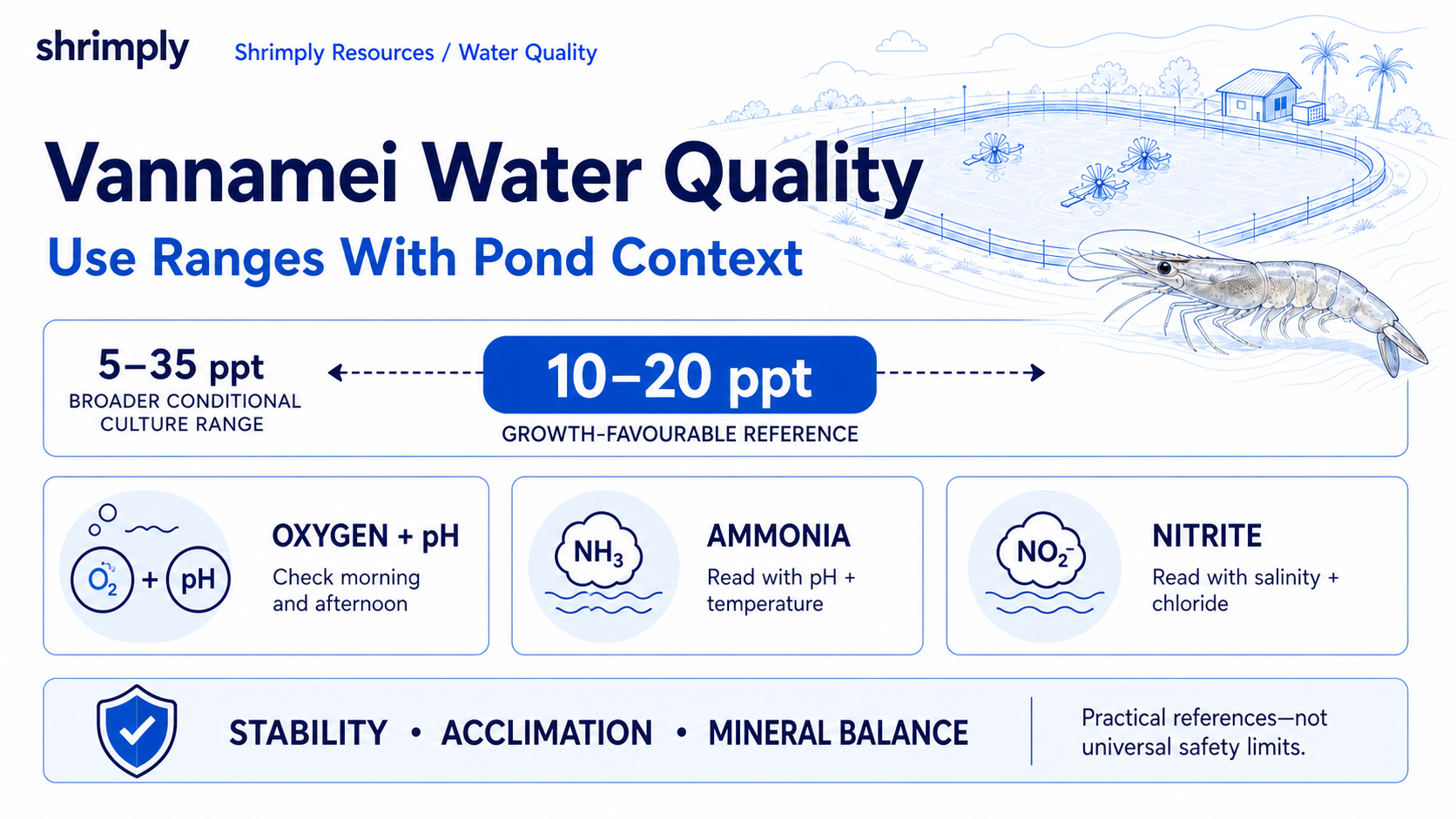
Vannamei Water Quality Parameters: Target Ranges & Warning Signs
Practical water quality reference for Pacific white shrimp (Litopenaeus vannamei), with contextual ranges for dissolved oxygen, temperature, pH, salinity, alkalinity, ammonia, nitrite, and nitrate.
vannamei water quality parametersshrimp water quality parametersvannamei water parameters
Feed and Inventory9 min read
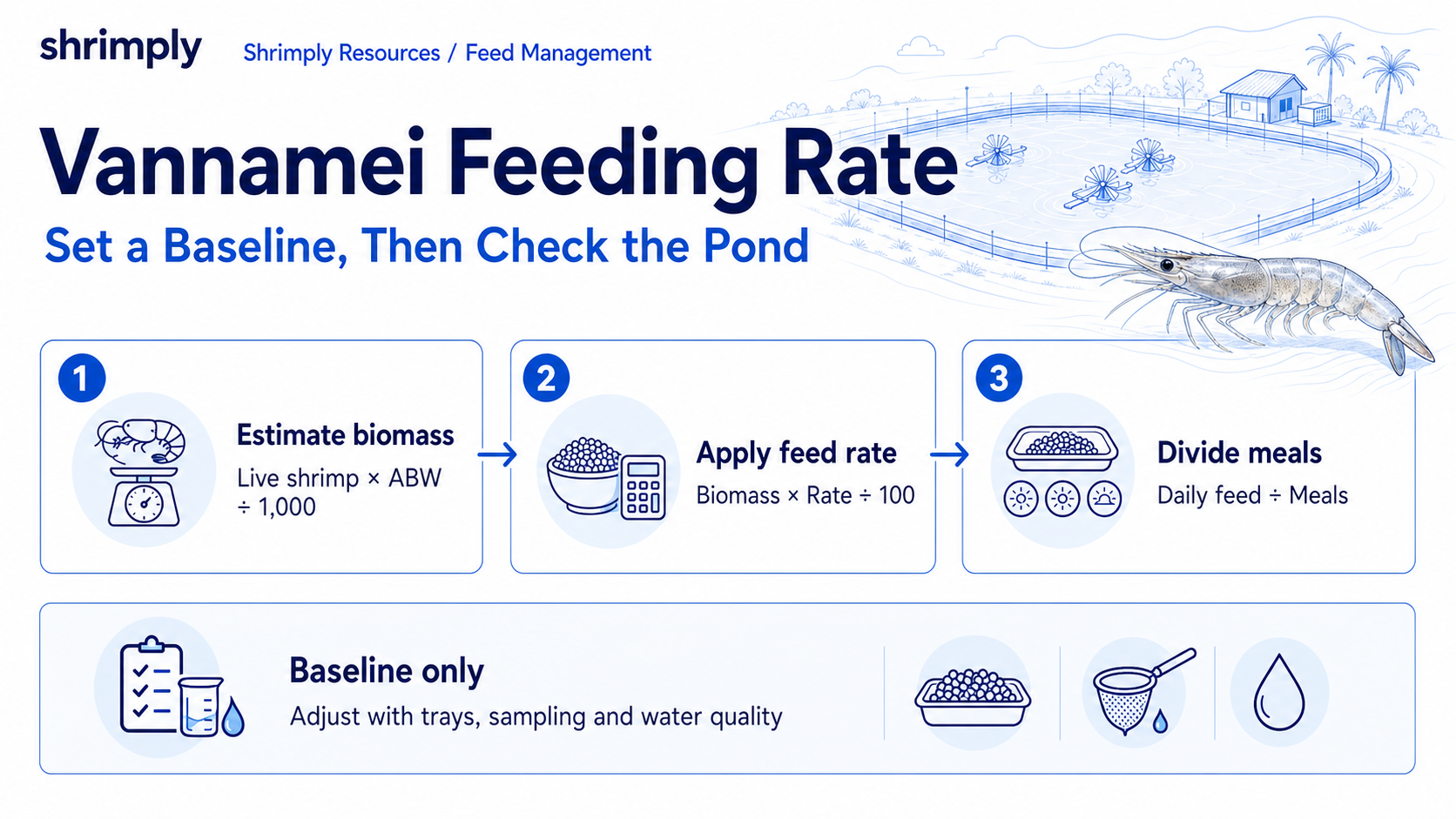
Vannamei Feeding Rate Chart & Calculator: Daily Feed by Body Weight
Estimate a baseline daily ration for Pacific white shrimp from standing biomass and average body weight, then adjust it using feed trays, recent sampling, harvests, and water quality.
vannamei feeding ratevannamei feeding chartshrimp feeding table
Farm Management8 min read
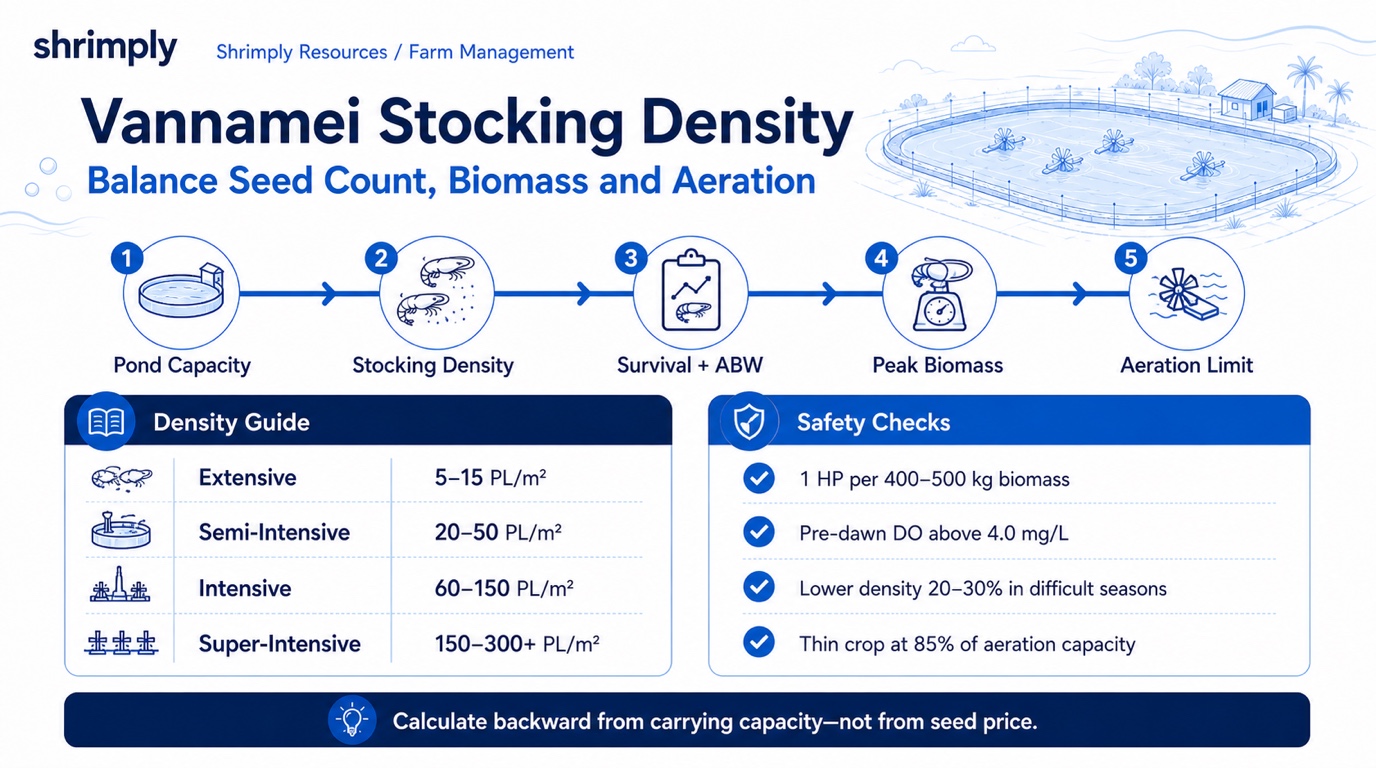
Vannamei Stocking Density per m²: Complete Guide & Calculator
Calculate Pacific white shrimp stocking density per m², post-larvae (PL) count, required aeration horsepower, and carrying capacity with our interactive calculator and farm guide.
vannamei stocking density per m2vannamei stocking densityshrimp stocking density
Growth and Sampling7 min read
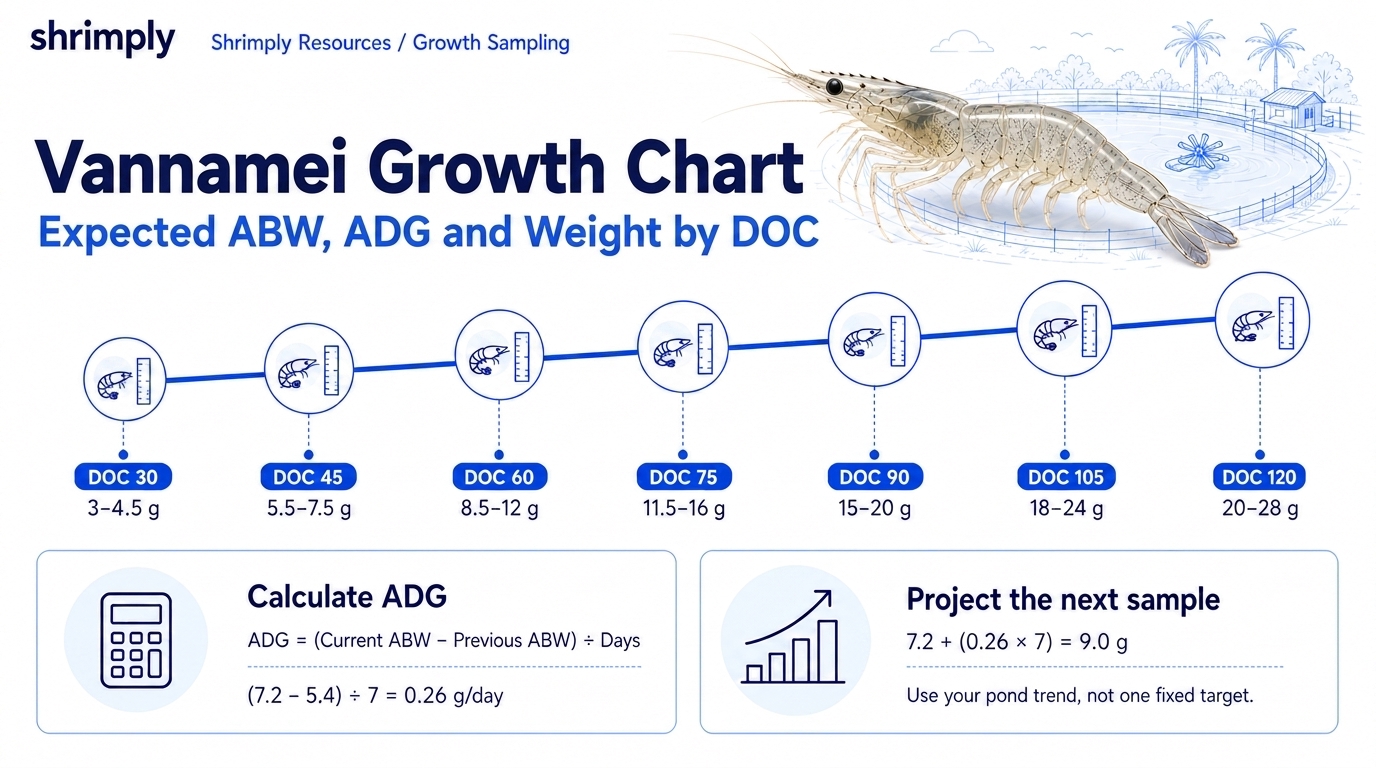
Vannamei Shrimp Growth Chart: Expected ABW, ADG and Weight by DOC
Track expected Pacific white shrimp (Litopenaeus vannamei) weight by day of culture (DOC). Benchmark your average body weight (ABW), daily growth rate (ADG), and shrimp count per kg.
vannamei growth chartvannamei growth rateshrimp growth by DOC
Water, Health, and Risk13 min read
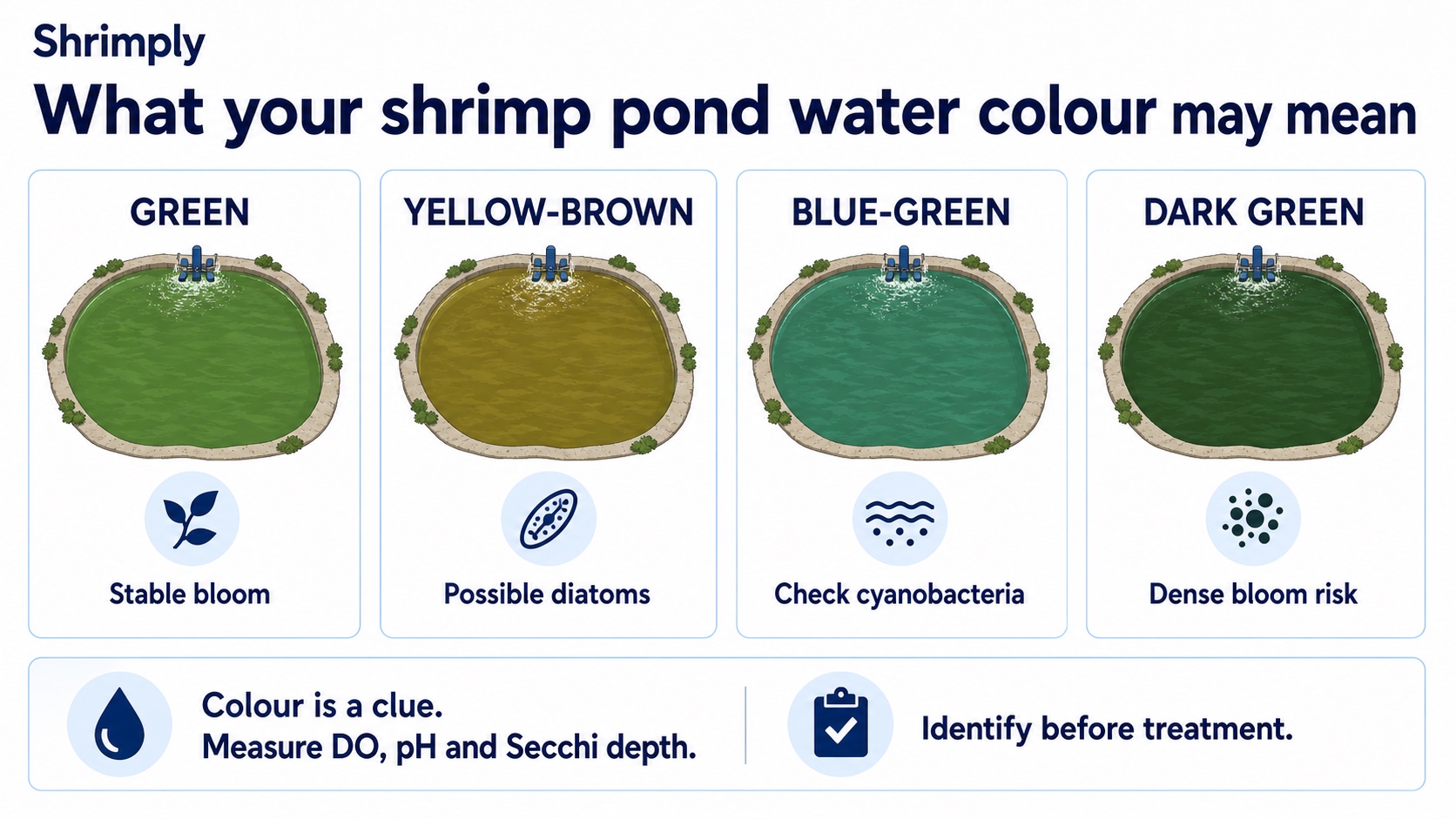
Shrimp Pond Water Colour: Algae Types, Risks and Solutions
Learn what green, brown, blue-green, red, clear, or dark shrimp-pond water may indicate and how to monitor and manage algae safely.
shrimp pond water colourphytoplankton in shrimp pondalgae in shrimp ponds
Feed and Inventory8 min read
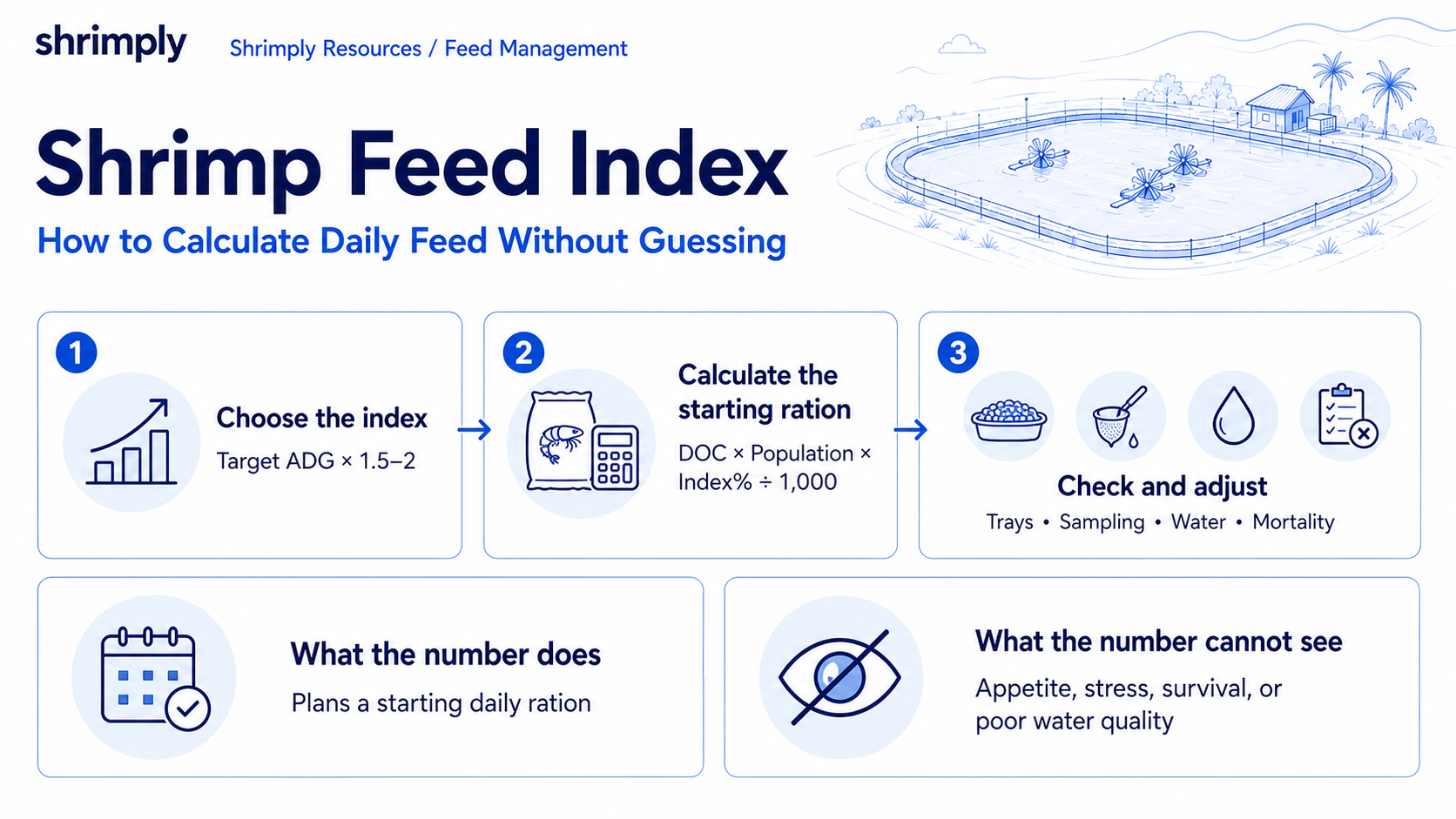
Shrimp Feed Index: How to Calculate Daily Feed Without Guessing
Learn how the shrimp feed index method estimates daily feed from DOC, population, and target ADG—and how to adjust it using real pond data.
shrimp feed indexfeed index formuladaily shrimp feed
Growth and Sampling8 min read
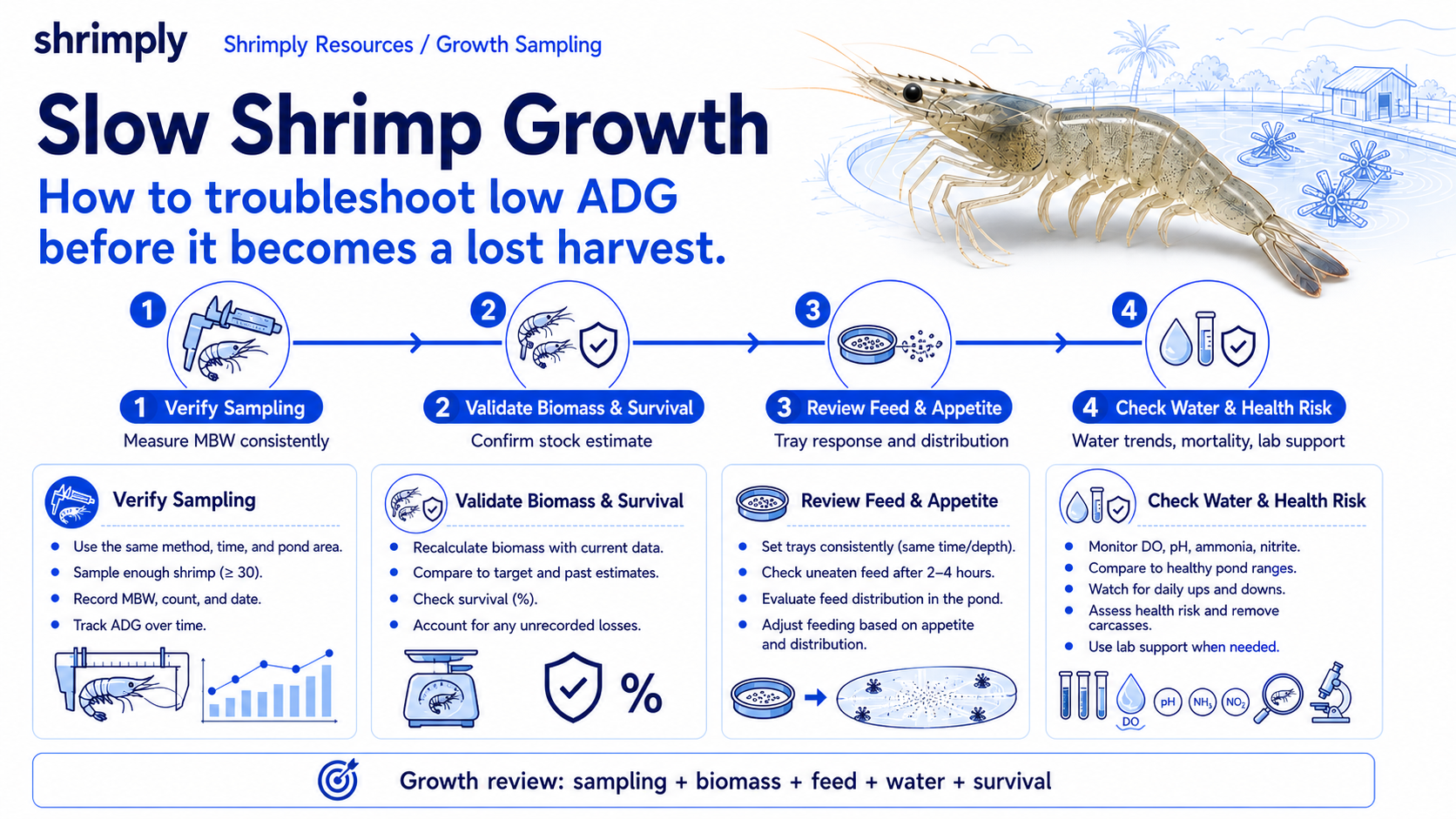
Slow Shrimp Growth: An ADG Troubleshooting Guide for Vannamei Farms
Why is shrimp growth slow? Use MBW, ADG, feed-tray response, water-quality trends, survival, and health observations to find the reason before the harvest plan drifts.
slow shrimp growthADGaverage daily growth
Water, Health, and Risk9 min read
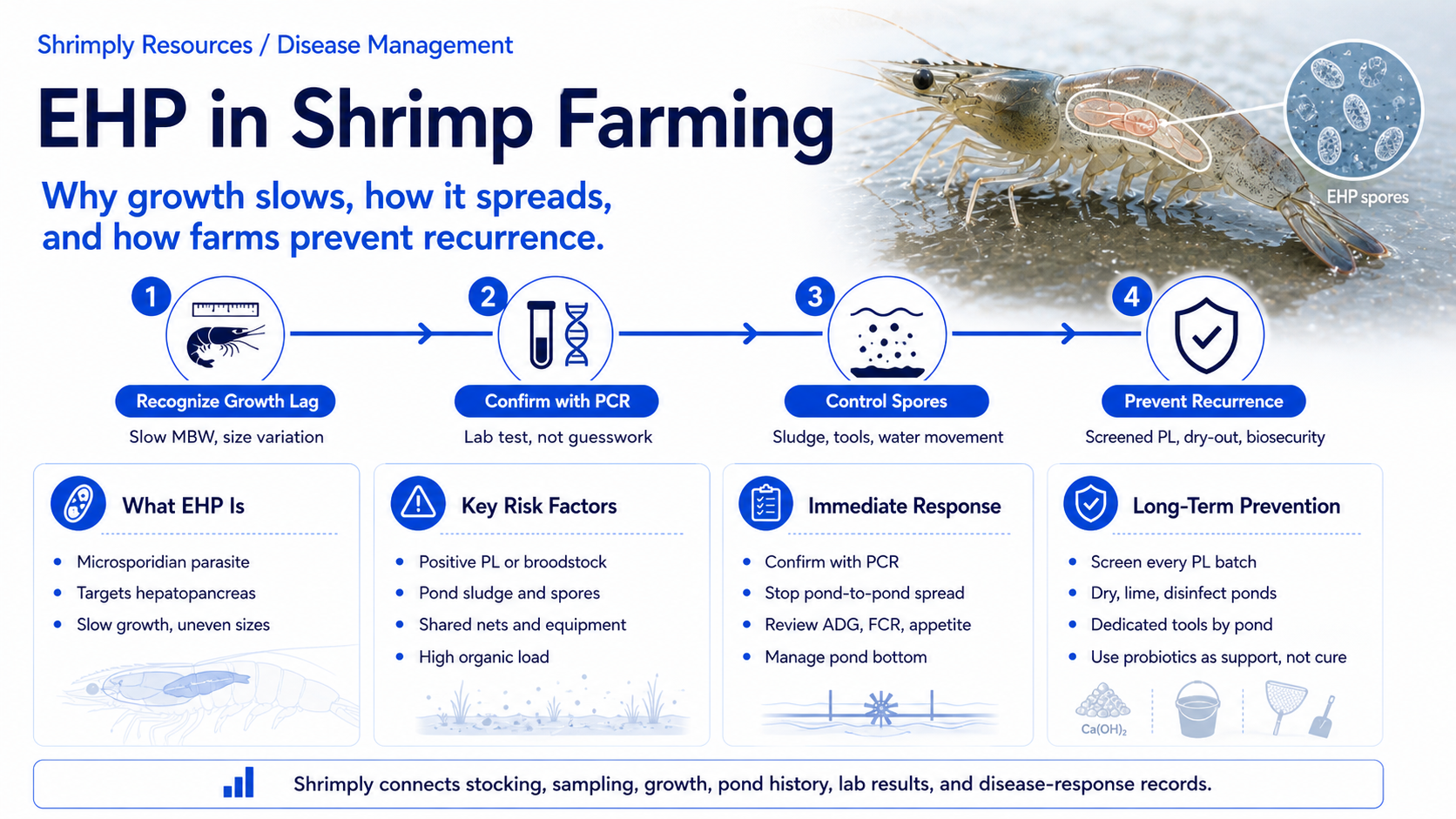
EHP in Shrimp Farming: Why Growth Slows and How Farms Prevent Recurrence
A practical guide to EHP management in vannamei shrimp, including Enterocytozoon hepatopenaei signs, PCR confirmation, pond risk parameters, treatment reality, Bacillus support, and long-term prevention.
EHPEnterocytozoon hepatopenaeiPCR
Water, Health, and Risk9 min read
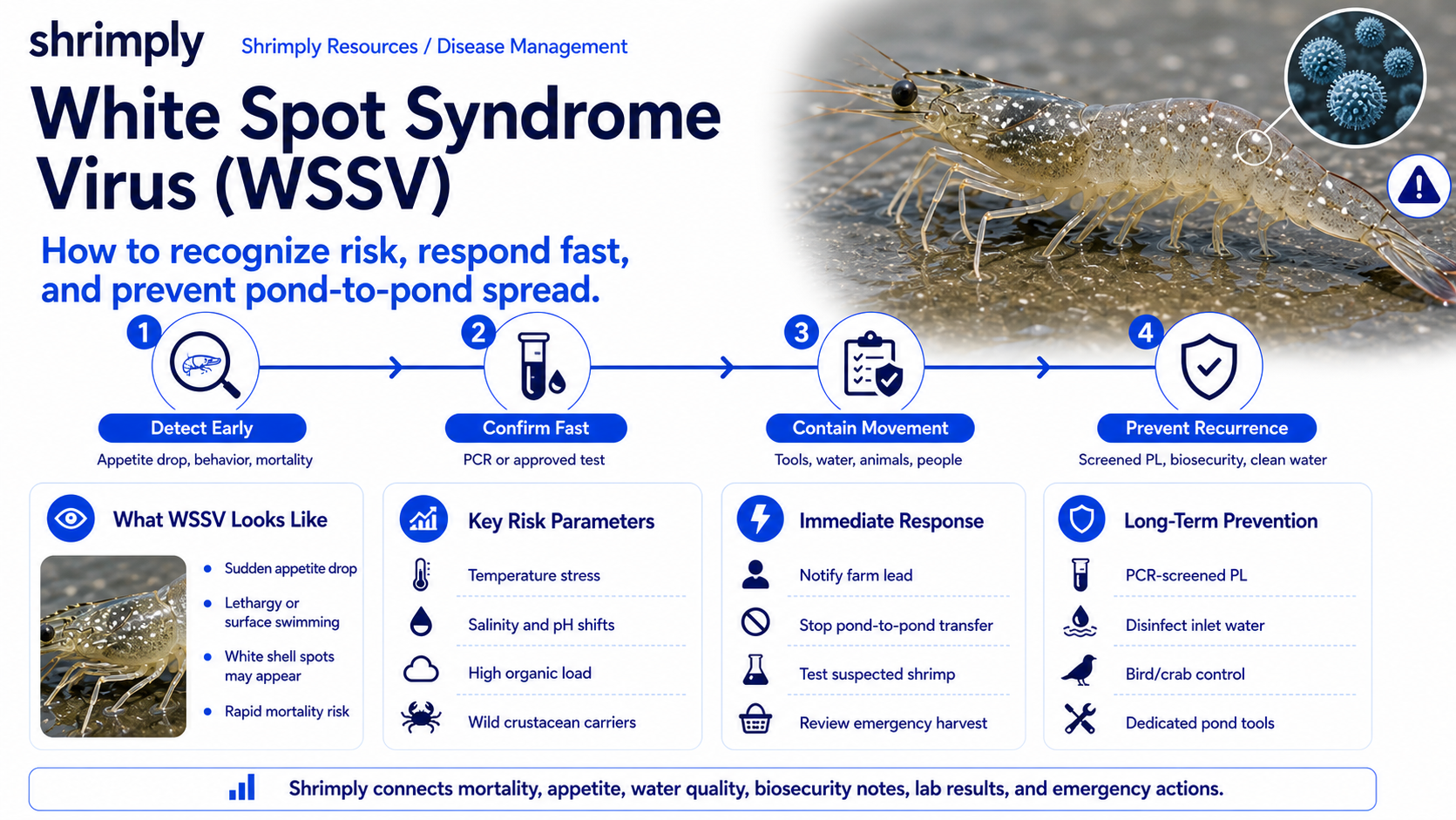
WSSV in Shrimp: White Spot Syndrome Virus Response and Prevention
A practical guide to WSSV in shrimp and white spot syndrome virus in vannamei, including early signs, rapid mortality risk, pond parameters, PCR confirmation, emergency response, and biosecurity prevention.
WSSVwhite spot syndrome viruswhite spot disease
Water, Health, and Risk9 min read
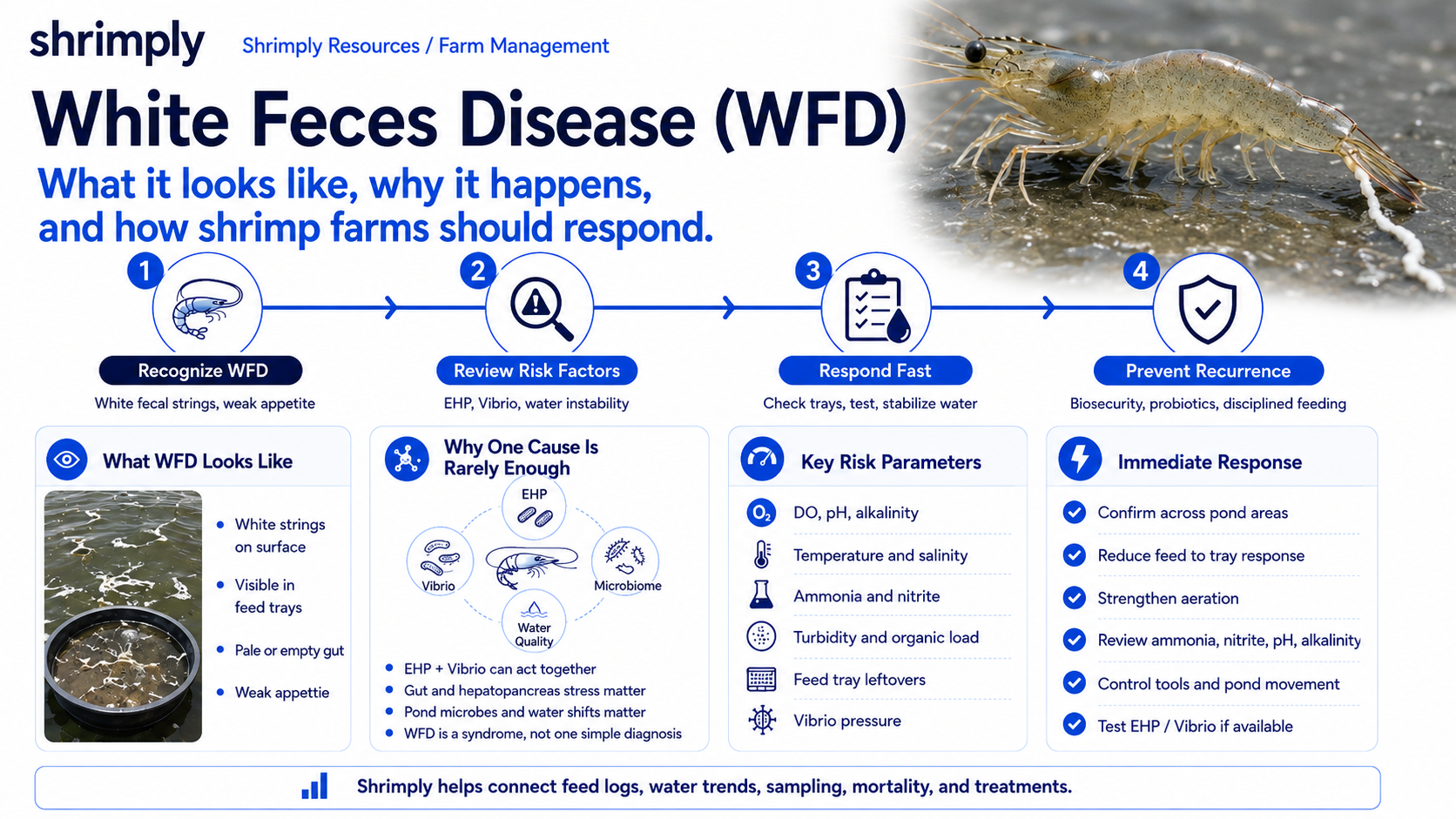
White Feces Disease in Shrimp (WFD): Causes, Response, and Prevention
A deep dive into shrimp white feces disease, WFD, or white feces syndrome, including signs, pond parameters, EHP and Vibrio risk, treatment response, Bacillus probiotics, and prevention.
white feces diseaseWFDWFS
Farm Management6 min read
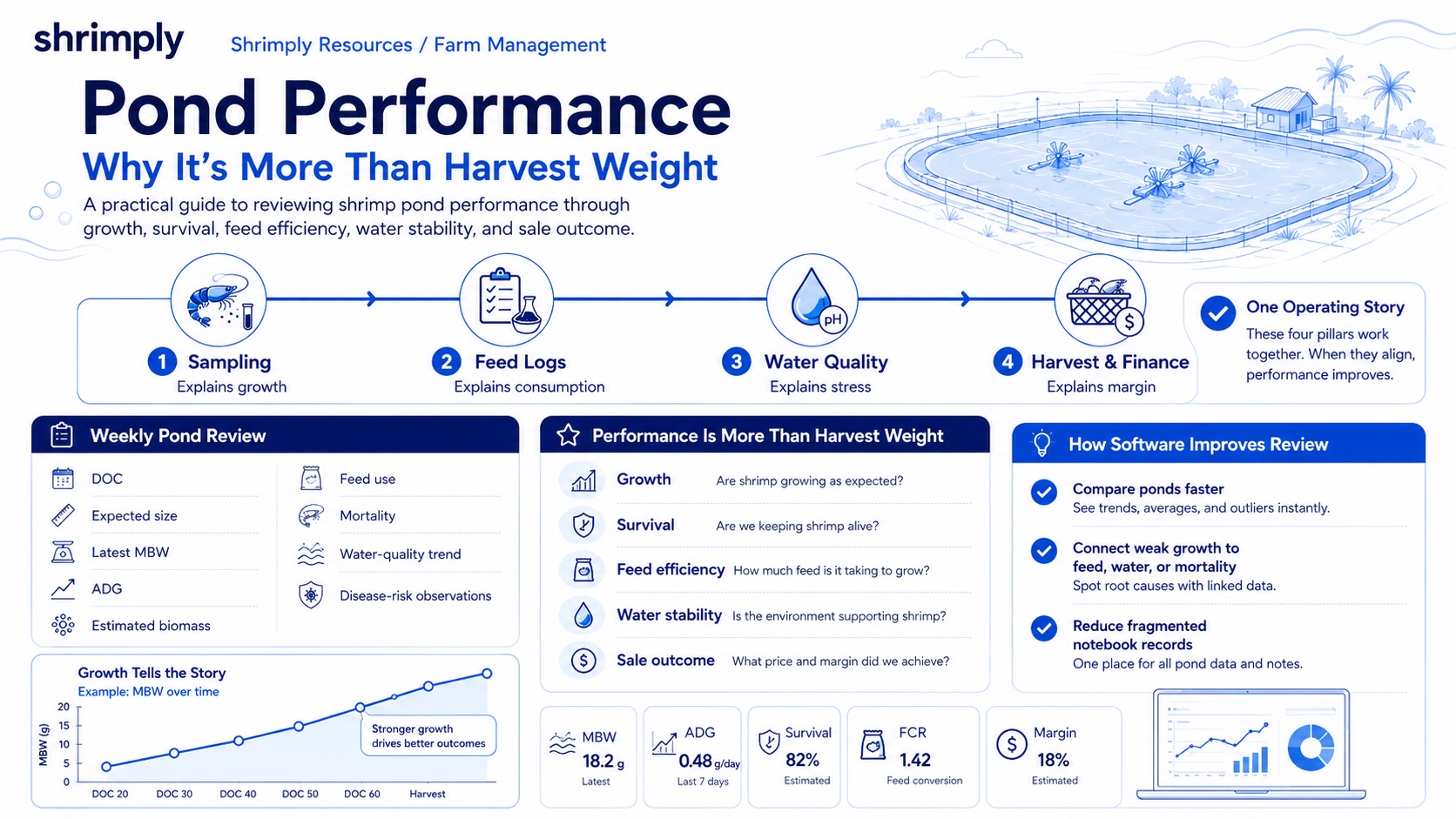
Pond Performance: The Shrimp Farm Scorecard That Actually Matters
Learn how shrimp farmers can read pond performance using stocking, survival, feed use, water quality, sampling, harvest, and cost records.
pond performanceDOCsurvival
Farm Management6 min read
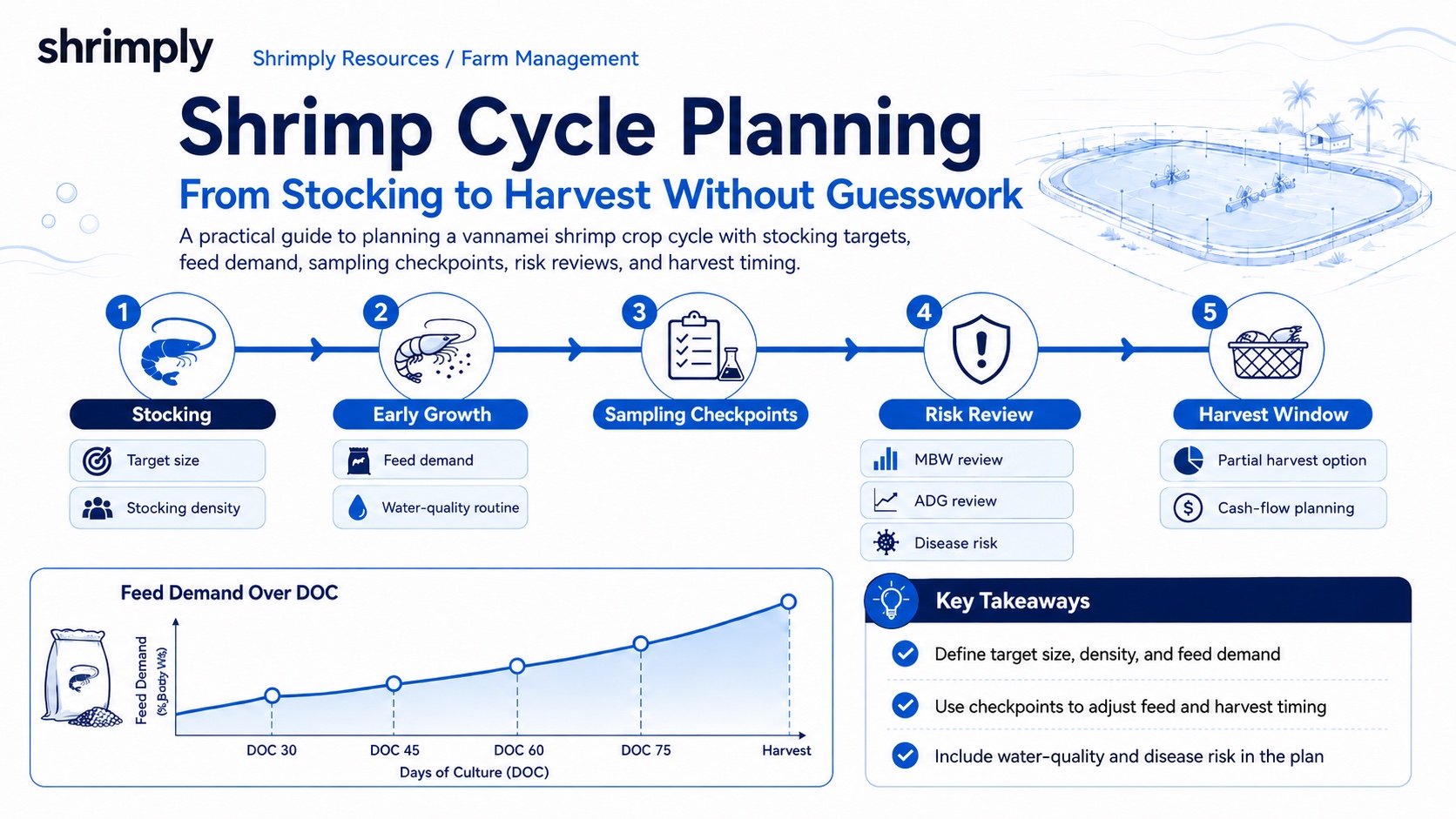
Shrimp Cycle Planning: From Stocking to Harvest Without Guesswork
A practical guide to planning a vannamei shrimp crop cycle with stocking targets, feed demand, sampling checkpoints, risk reviews, and harvest timing.
cycle planningstockingharvest timing
Farm Management7 min read
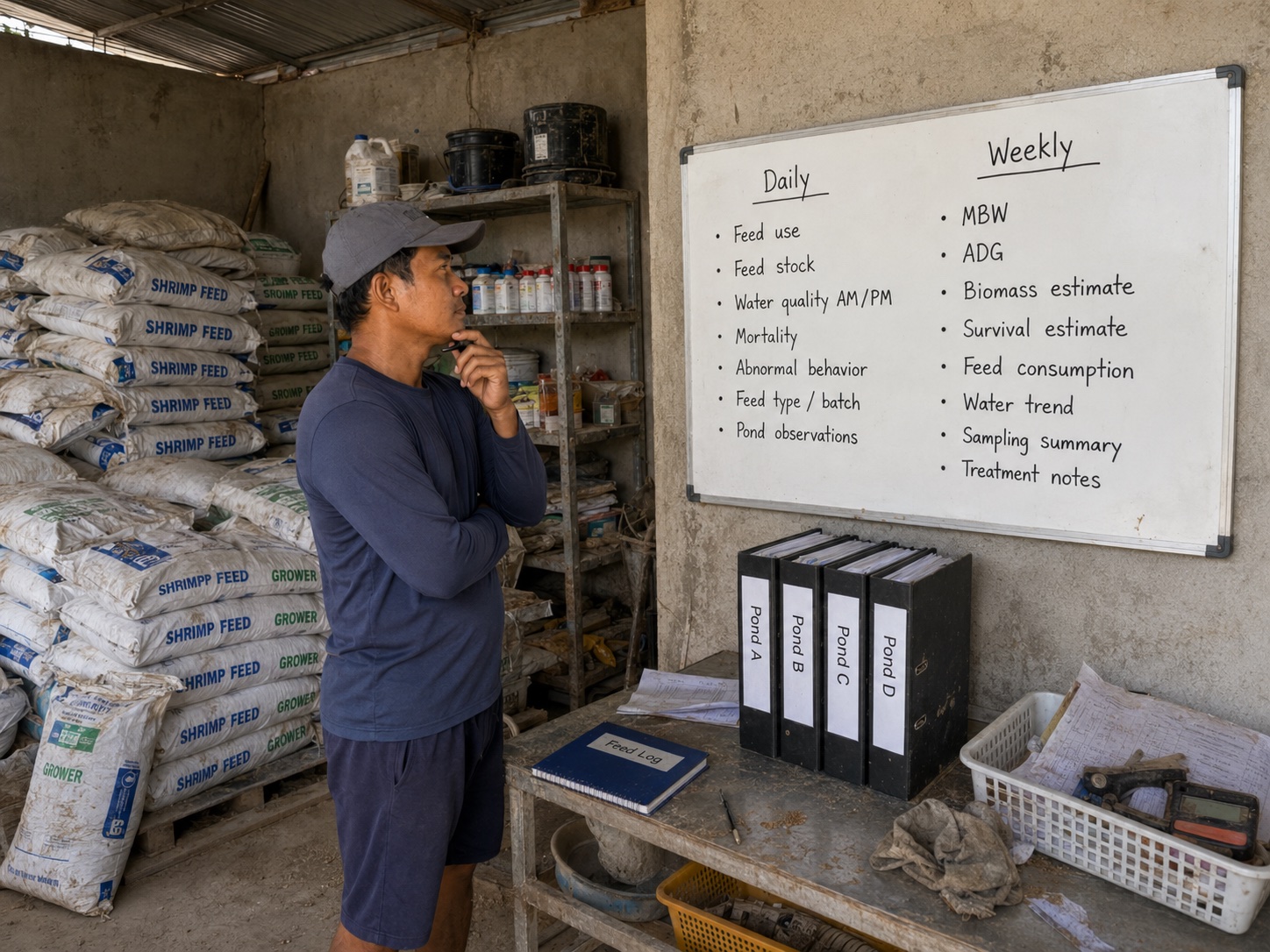
Shrimp Farm Record Keeping: What to Track Daily, Weekly, and Per Cycle
See which shrimp farm records matter most for feed control, water quality, growth sampling, mortality, harvests, and financial performance.
record keepingdaily logswater quality
Feed and Inventory7 min read
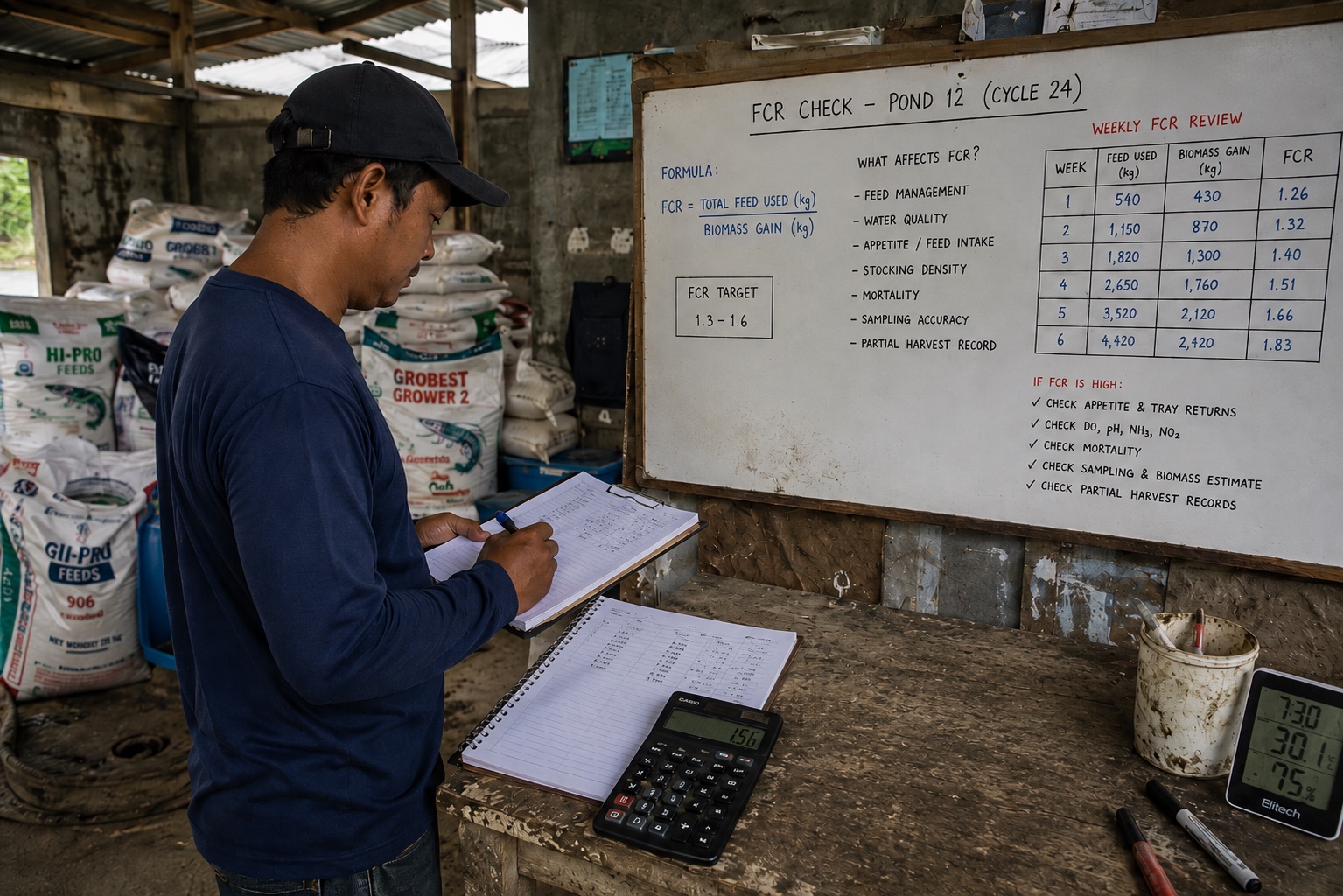
Improving FCR in Shrimp Farming: How to Use Feed Conversion Ratio Correctly
Understand shrimp feed conversion ratio, why FCR matters, what can distort it, and how farms can improve FCR with better feed, biomass, mortality, and harvest records.
FCRimproving FCRfeed conversion ratio
Feed and Inventory6 min read
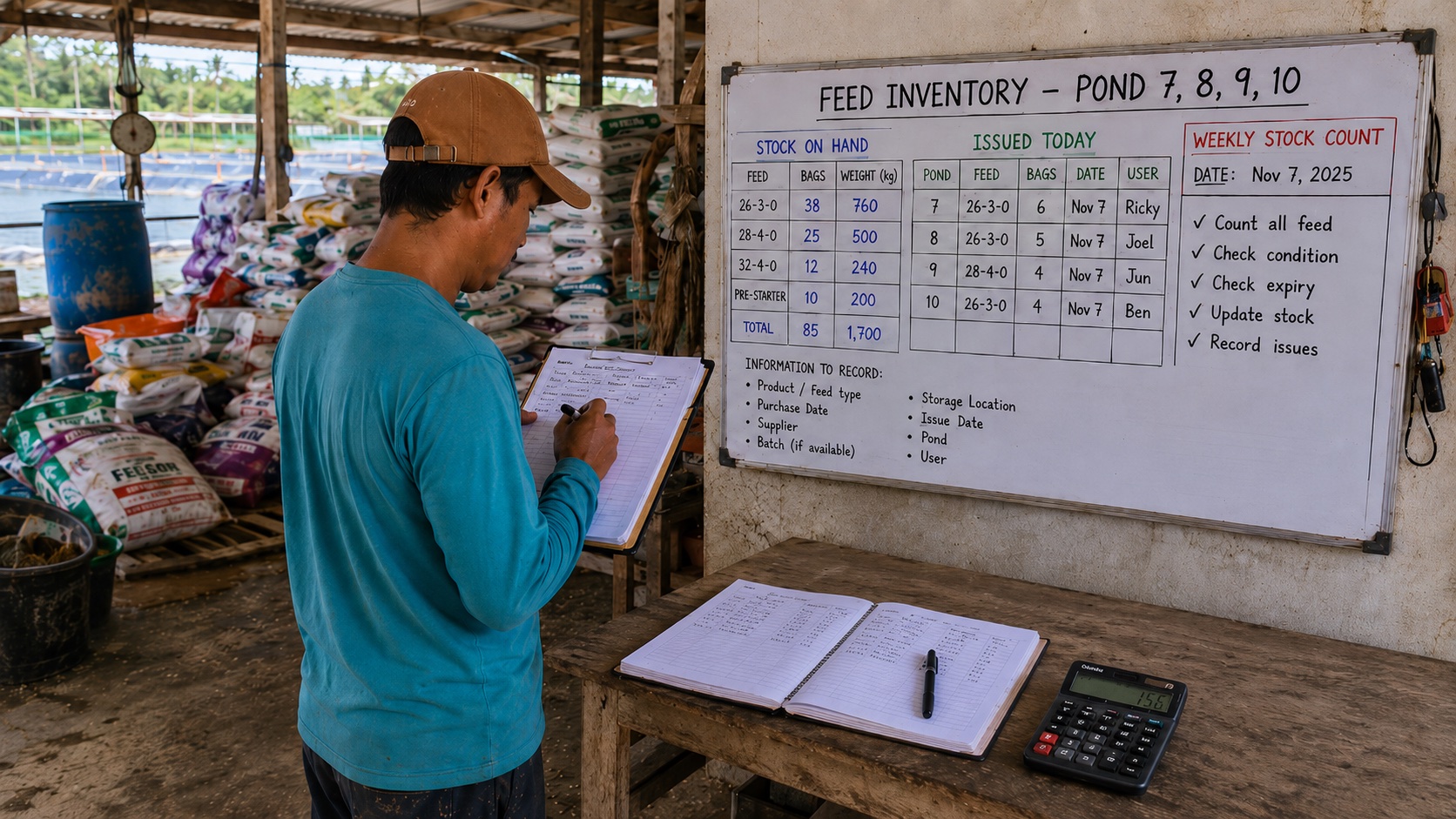
Feed Inventory Control for Shrimp Farms: Avoid Stockouts, Waste, and Bad FCR
Learn how shrimp farms can manage feed stock, feed batches, reorder timing, and pond-level feed use to protect growth and cost control.
feed inventorystockoutreorder
Water, Health, and Risk7 min read
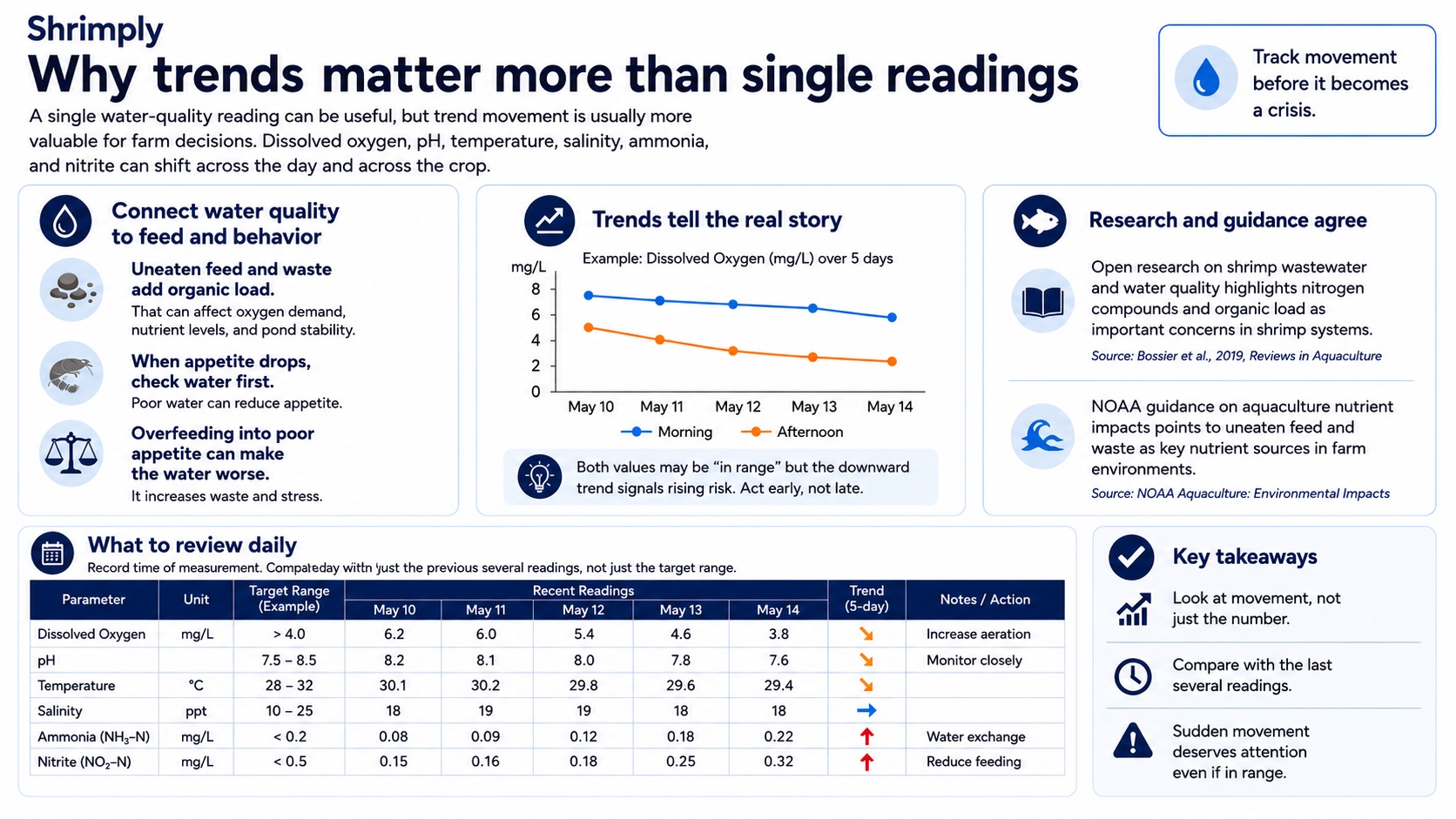
Shrimp Pond Water Quality Trends: Reading DO, pH, Salinity, Ammonia, and Nitrite Together
Which shrimp pond water parameters should you test? Learn how to review dissolved oxygen, pH, temperature, salinity, ammonia, and nitrite together before they become a pond-risk pattern.
shrimp water qualityshrimp pond water parametersdissolved oxygen
Water, Health, and Risk7 min read
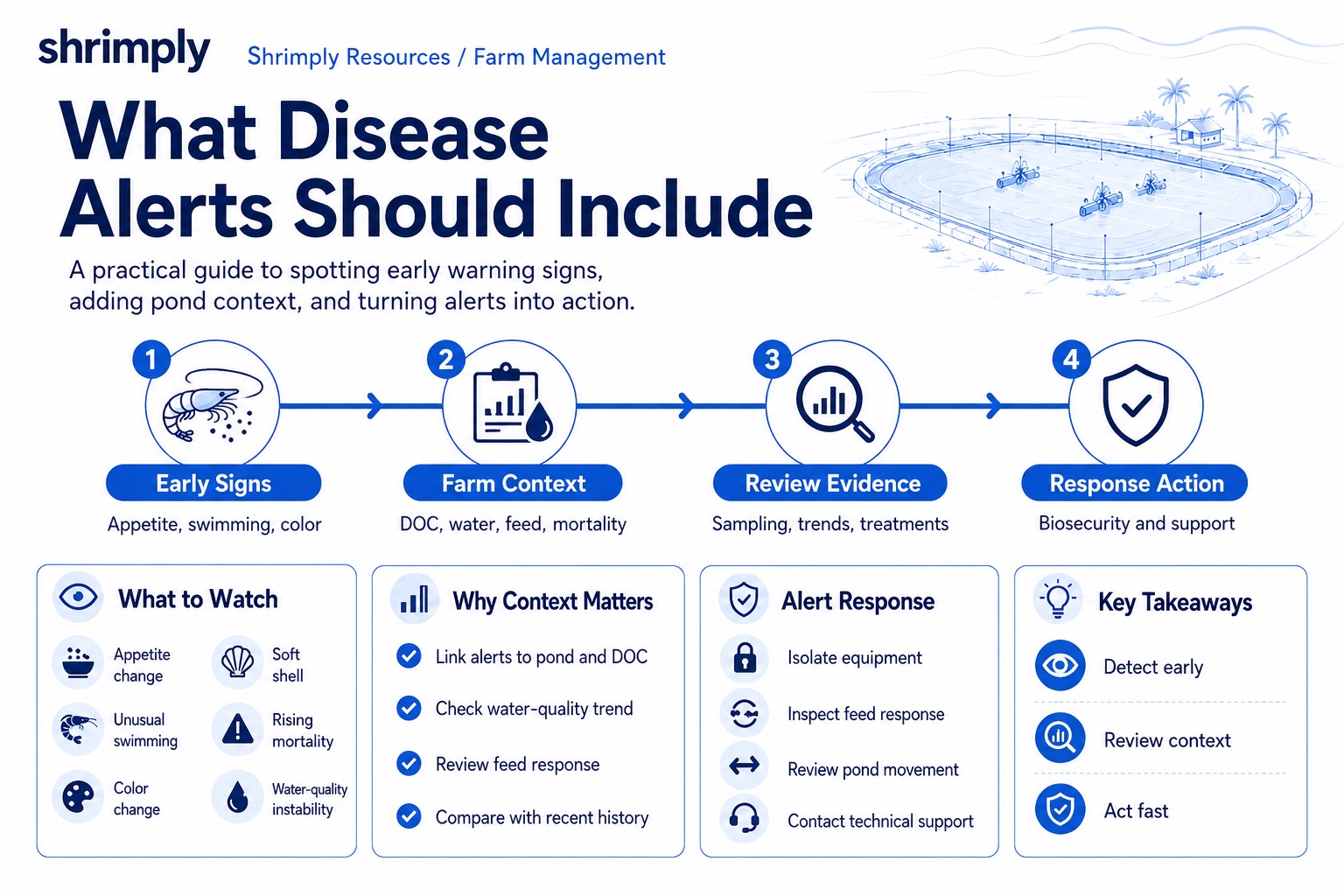
Shrimp Disease Alerts: Turning Farm Observations Into Faster Response
What are the early signs of shrimp disease? Use mortality, appetite, water quality, behaviour, and biosecurity observations to create a faster, evidence-based farm response.
shrimp disease signsshrimp disease preventiondisease alerts
Water, Health, and Risk6 min read
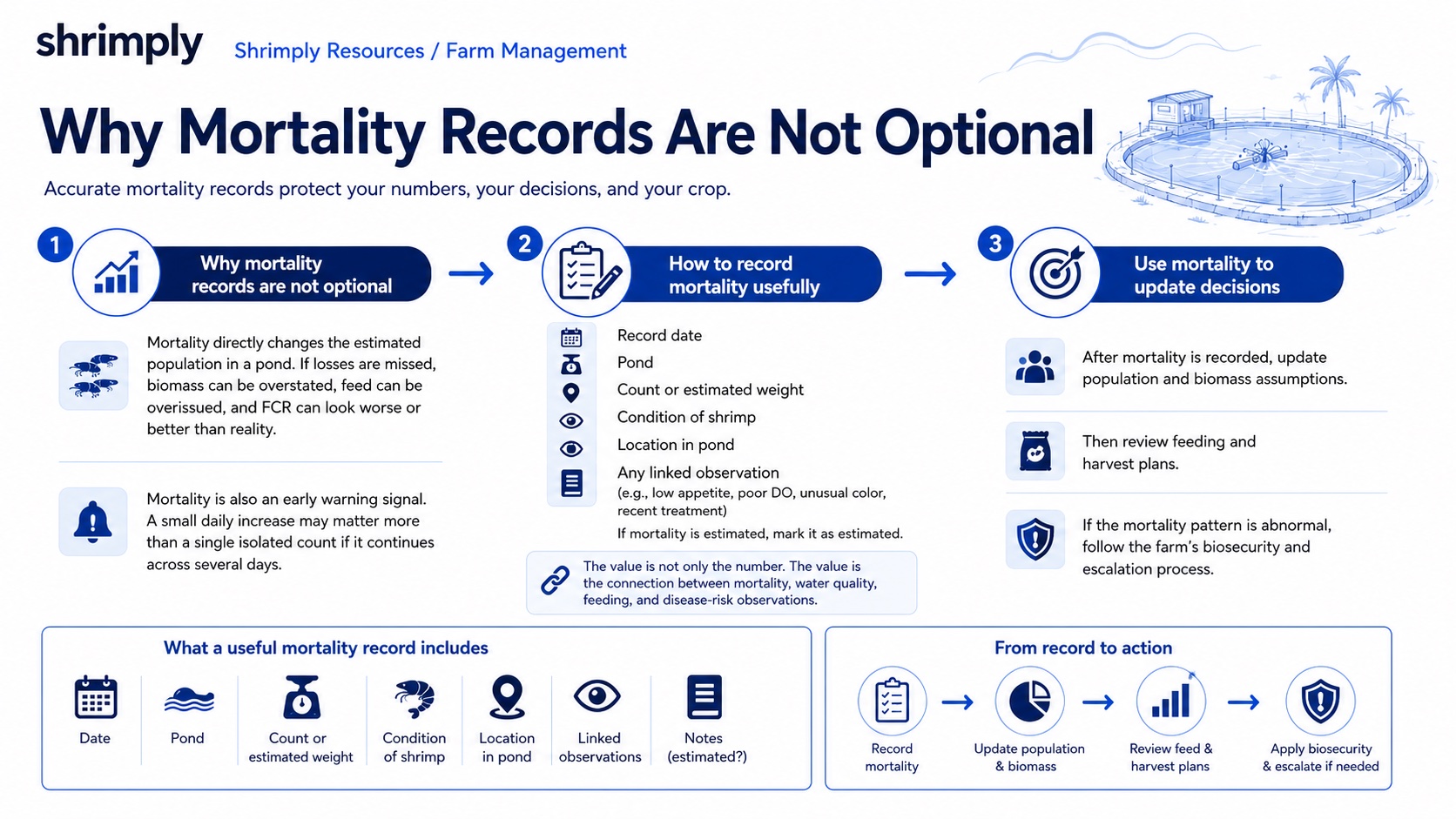
Shrimp Mortality Tracking: How Loss Records Protect Biomass, FCR, and Harvest Planning
Why are shrimp dying in my pond? Learn how mortality records help farmers investigate sudden loss, protect biomass estimates, improve FCR accuracy, and trigger a timely disease-risk response.
shrimp mortalityshrimp dyingsudden mortality
Harvest and Finance6 min read
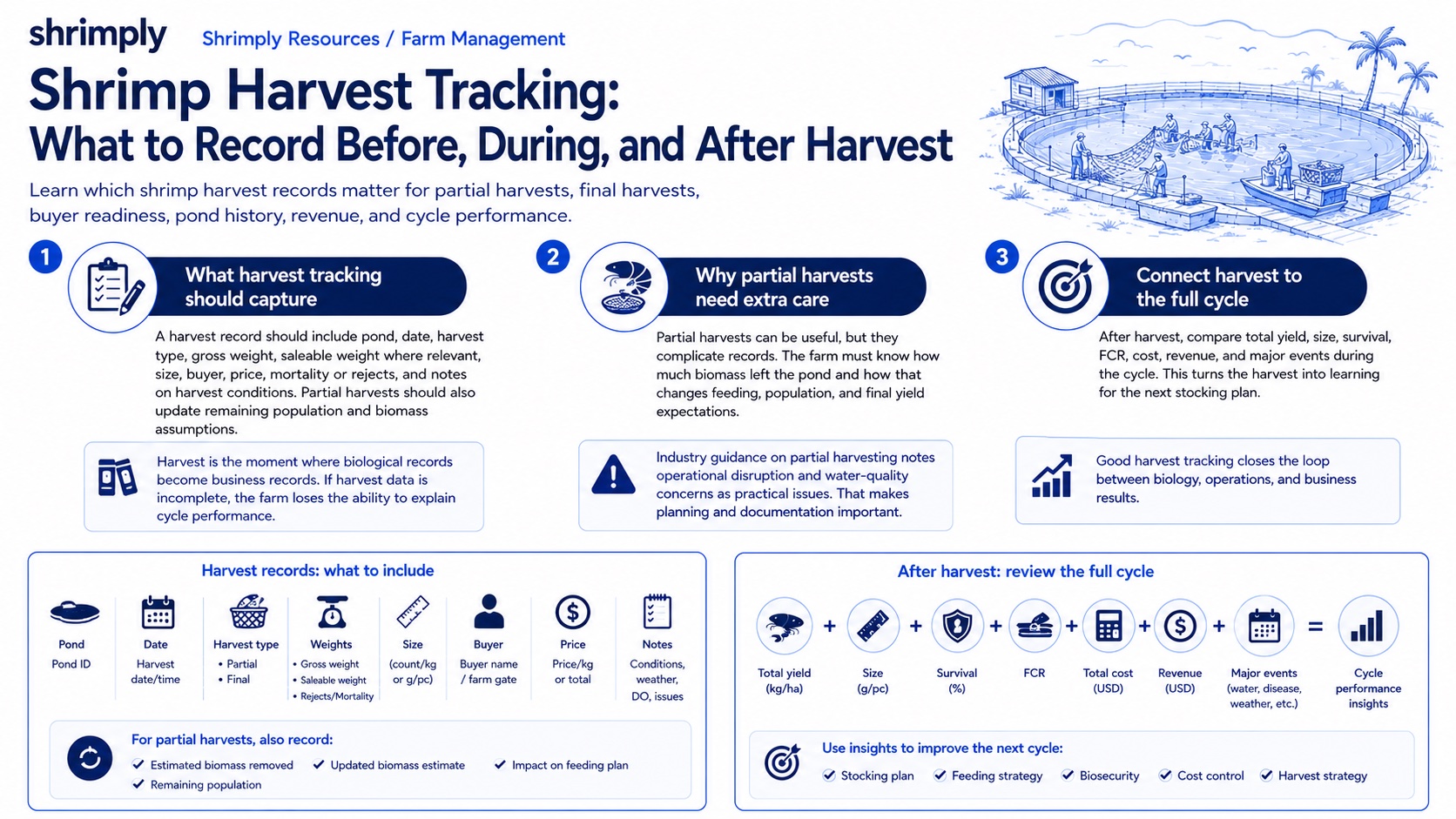
Shrimp Harvest Tracking: What to Record Before, During, and After Harvest
When should shrimp farmers harvest or partially harvest? Learn which pond, size, biomass, buyer, price, and cycle records support a well-documented harvest decision.
when to harvest shrimpshrimp harvestpartial harvest
Harvest and Finance7 min read
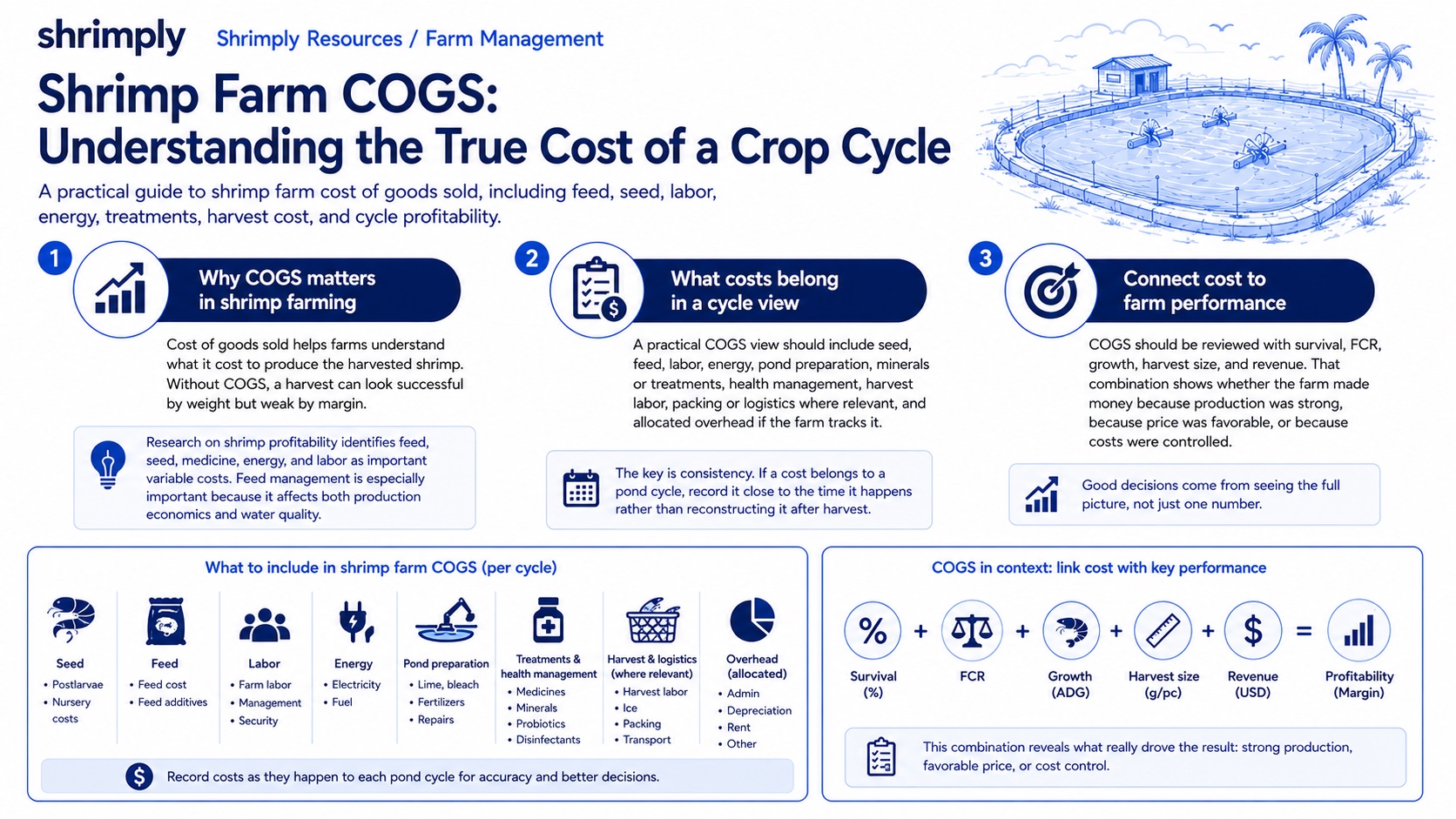
Shrimp Farm COGS: Understanding the True Cost of a Crop Cycle
Is your shrimp crop profitable? Learn how to calculate shrimp farm cost of goods sold using feed, seed, labor, energy, treatments, harvest costs, and kilograms sold.
shrimp farming profitabilityshrimp farm costCOGS
Harvest and Finance6 min read
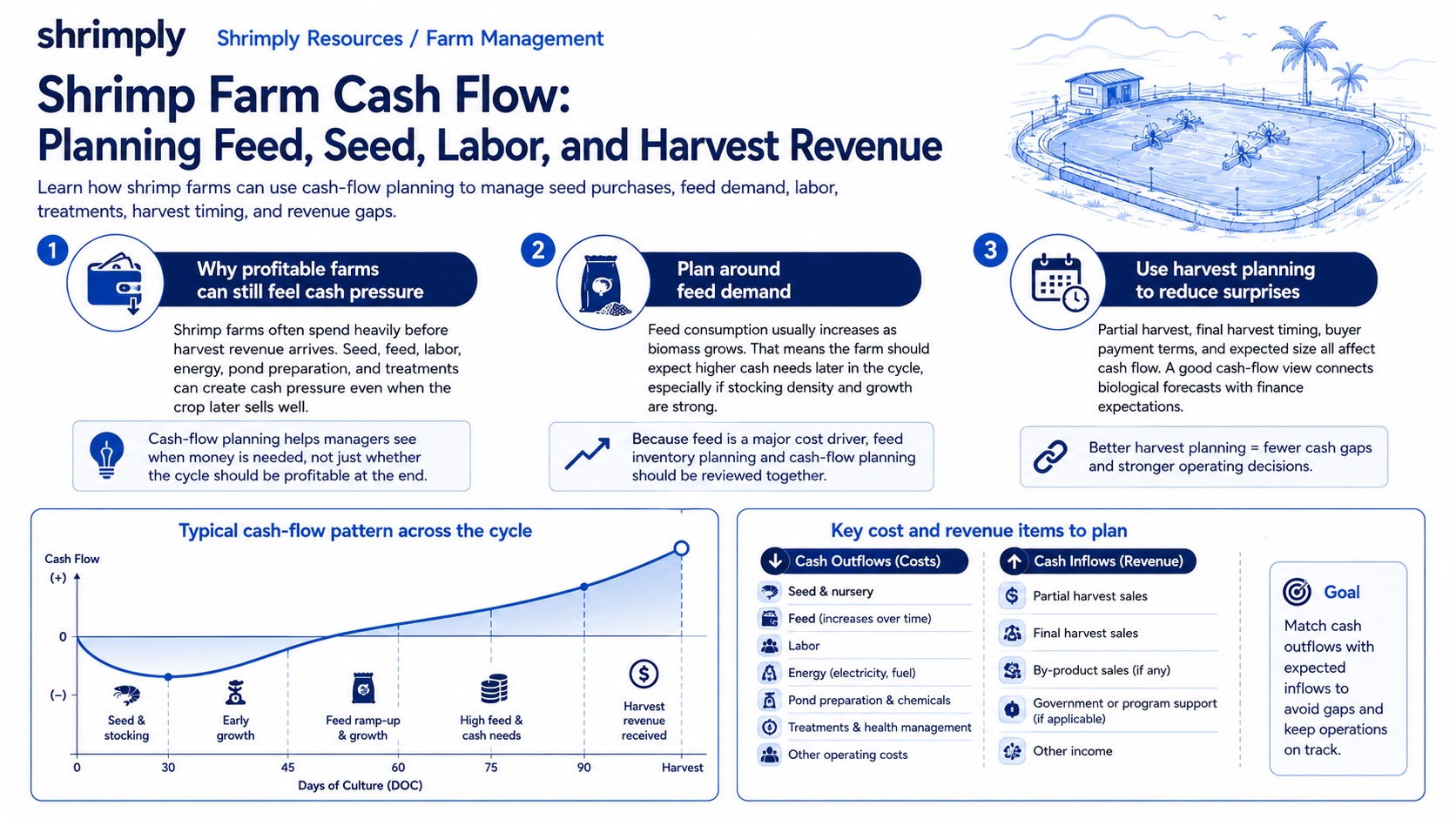
Shrimp Farm Cash Flow: Planning Feed, Seed, Labor, and Harvest Revenue
Learn how shrimp farms can use cash-flow planning to manage seed purchases, feed demand, labor, treatments, harvest timing, and revenue gaps.
cash flowfarm financefeed demand