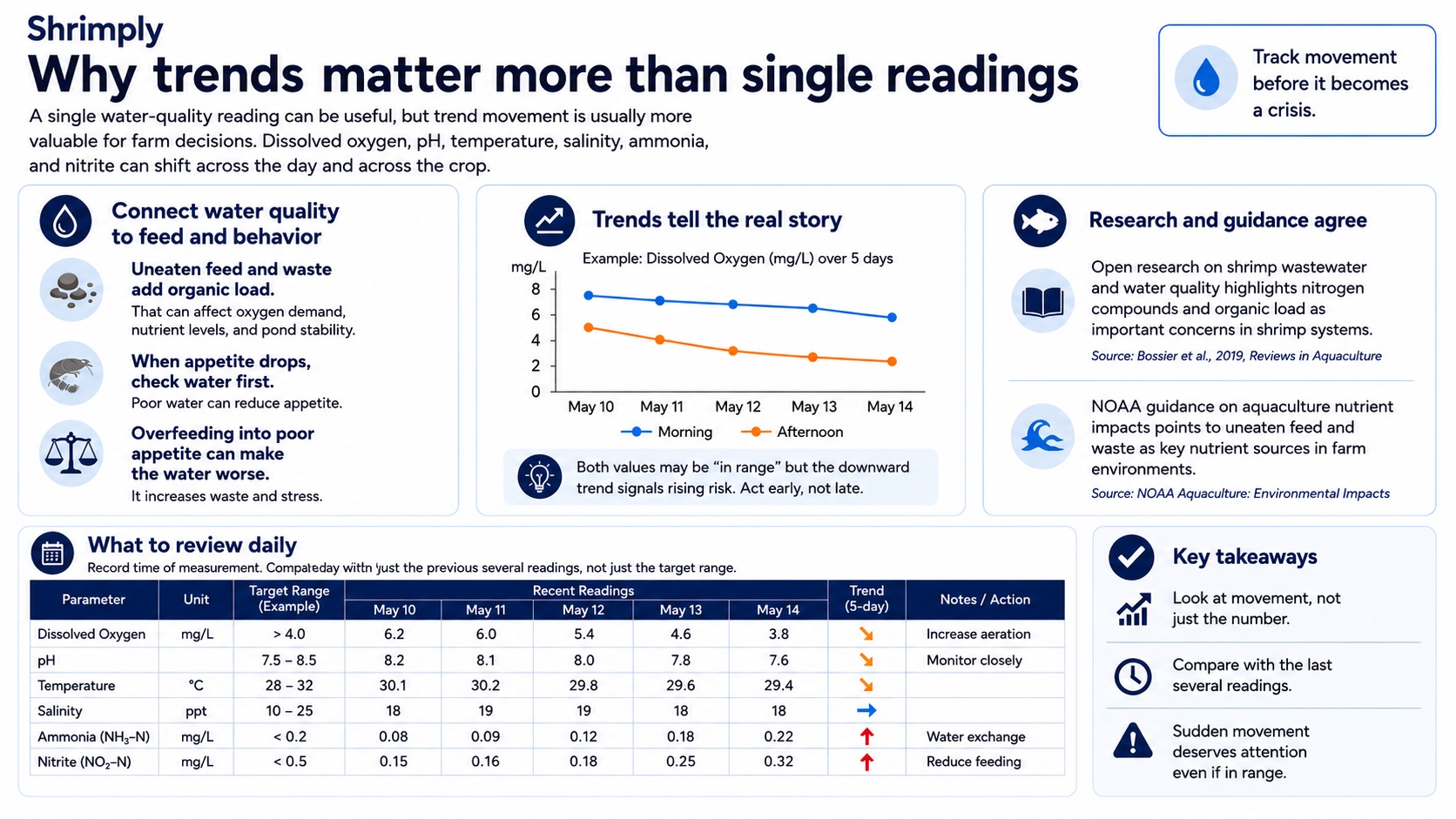
Why trends matter more than single readings
A single water-quality reading can be useful, but trend movement is usually more valuable for farm decisions. Dissolved oxygen, pH, temperature, salinity, ammonia, and nitrite can shift across the day and across the crop.
Open research on shrimp wastewater and water quality highlights nitrogen compounds and organic load as important concerns in shrimp systems. For farmers, the practical lesson is to track movement before it becomes a crisis.
Connect water quality to feed and behavior
Uneaten feed and waste add organic load. That can affect oxygen demand, nutrient levels, and pond stability. NOAA guidance on aquaculture nutrient impacts also points to uneaten feed and waste as key nutrient sources in farm environments.
When appetite drops, farmers should check water before assuming shrimp simply need less feed. Poor water can reduce appetite, and overfeeding into poor appetite can make the water worse.
What to review daily
At minimum, track the farm's key operational parameters consistently and record time of measurement. Compare today with the previous several readings, not just the target range. Sudden movement deserves attention even if the number has not crossed an alarm threshold.
For practical grow-out reference ranges and the pond context that changes risk, use the Vannamei Water Quality Parameters guide.
What to apply on the farm
- Record reading time with every water-quality entry.
- Review the last several readings before deciding action.
- Compare water movement with feed response and mortality.
- Flag sudden changes even before readings become extreme.
What water parameters should I test in a shrimp pond?
At minimum, consistently track the farm's operational parameters for dissolved oxygen, pH, temperature, salinity, ammonia, and nitrite, with the time of each reading. The right monitoring plan also depends on the farm system, season, stocking density, and local technical guidance.
What should I check when dissolved oxygen drops in a shrimp pond?
Confirm the reading and timing, check aeration and shrimp behaviour, review recent feeding and organic load, compare pH and temperature movement, and inspect ammonia and nitrite where available. Escalate through the farm's oxygen-response procedure rather than assuming one measurement explains the cause.
Why should ammonia, pH, and temperature be reviewed together?
These conditions interact: pH and temperature affect the proportion of ammonia present in the more toxic un-ionised form. A trend-based review is more useful than treating any one measurement as a complete diagnosis.
Aquaculture engineers and vannamei shrimp farm practitioners dedicated to precision pond data, evidence-based water quality management, and biological yield optimization.
Ph.D. in Aquaculture Engineering, 18+ years tropical penaeid farm advisory and biosecurity audit experience
Shrimp water quality monitoring software
Explore how shrimp water quality monitoring software connects with this farm guide in Shrimply.
Vannamei Water Quality Parameters: Target Ranges & Warning Signs
Practical water quality reference for Pacific white shrimp (Litopenaeus vannamei), with contextual ranges for dissolved oxygen, temperature, pH, salinity, alkalinity, ammonia, nitrite, and nitrate.
Shrimp Pond Water Colour: Algae Types, Risks and Solutions
Learn what green, brown, blue-green, red, clear, or dark shrimp-pond water may indicate and how to monitor and manage algae safely.
Shrimp farming resources library
Browse more practical Shrimply guides for vannamei farm operations and management.