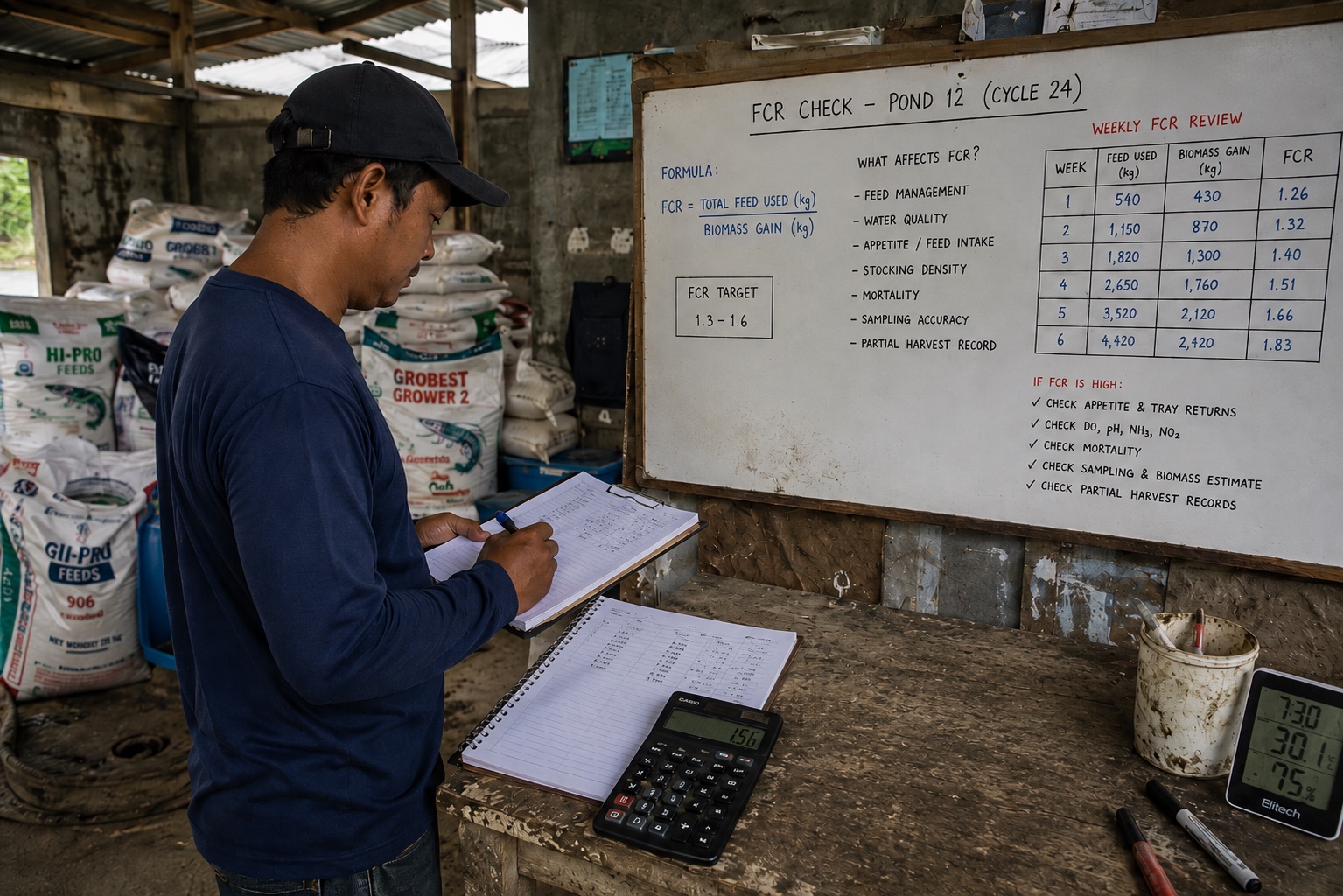
The basic shrimp FCR formula
The standard formula is: FCR = total feed used / biomass gained. If a pond used 10,000 kg of feed and gained 8,000 kg of shrimp biomass, the FCR is 1.25.
For shrimp ponds, biomass gained should account for the crop result, not just the final standing biomass. A practical farm formula is: FCR = total feed used / (harvested biomass + remaining biomass - initial stocked biomass). Many farms use initial stocked biomass as a small correction because post-larvae are tiny, but it is still more accurate to include it when the data exists.
For ponds with partial harvests, add every partial harvest to the biomass result. Otherwise the farm may overstate feed use against only the final harvest and make FCR look worse than it really was.
What FCR tells a shrimp farm
Feed conversion ratio is one of the most important production indicators because feed is a major operating cost in shrimp farming. A lower FCR usually means feed is being converted into shrimp biomass more efficiently, but the number only helps if feed and biomass records are accurate.
FAO material on vannamei notes that systems such as bacterial floc can reduce dependence on high-protein feeds and improve cost efficiency. That reinforces the practical point: FCR is connected to the whole culture system, not only the feeding table.
Why FCR can be wrong
FCR can be distorted when feed movement is not recorded, mortality is missed, harvest weights are incomplete, or sampling overestimates biomass. Partial harvests can also confuse FCR if harvested biomass is not tied back to the pond cycle.
Farmers should avoid treating FCR as a standalone score. A pond with low growth and low feed use may look efficient but still miss the harvest target. A pond with high feed use and poor water quality may show the opposite problem.
How to use FCR every week
Use FCR as a question generator. If FCR is rising, check appetite, tray returns, DO, ammonia, nitrite, mortality, and recent sampling accuracy. Improving FCR in shrimp farming usually comes from tighter feed records, better biomass estimates, cleaner tray interpretation, and earlier response to water-quality stress. If FCR improves sharply, check whether biomass or harvest records are complete before assuming performance improved.
Use the Vannamei Feeding Rate Chart & Calculator to set a biomass-based starting ration, then confirm it with trays, water quality, and recent pond records.
What to apply on the farm
- Use actual feed issued to the pond, not estimated bags.
- Keep mortality and harvest records current.
- Review FCR beside MBW, ADG, biomass, and water quality.
- Investigate sudden FCR changes instead of celebrating or blaming too quickly.
How do I calculate FCR in shrimp farming?
Calculate FCR as total feed used divided by biomass gained. For a useful pond result, include every partial harvest, final harvest, and remaining biomass, then subtract initial stocked biomass where reliable records exist.
Why is my shrimp FCR increasing?
A rising FCR can be linked to excess feed, weak appetite, inaccurate biomass estimates, missed mortality, incomplete harvest records, water-quality stress, or feed stock errors. Review feed trays, DO, ammonia, nitrite, sampling, mortality, and harvest entries together before changing the ration.
Aquaculture engineers and vannamei shrimp farm practitioners dedicated to precision pond data, evidence-based water quality management, and biological yield optimization.
M.Sc. in Aquatic Animal Nutrition, 14+ years commercial vannamei feed formulation and feeding rate optimization
Shrimp feed management software
Explore how shrimp feed management software connects with this farm guide in Shrimply.
Shrimp Feed Index: How to Calculate Daily Feed Without Guessing
Learn how the shrimp feed index method estimates daily feed from DOC, population, and target ADG—and how to adjust it using real pond data.
Vannamei Feeding Rate Chart & Calculator: Daily Feed by Body Weight
Estimate a baseline daily ration for Pacific white shrimp from standing biomass and average body weight, then adjust it using feed trays, recent sampling, harvests, and water quality.
Shrimp farming resources library
Browse more practical Shrimply guides for vannamei farm operations and management.