Quick answer
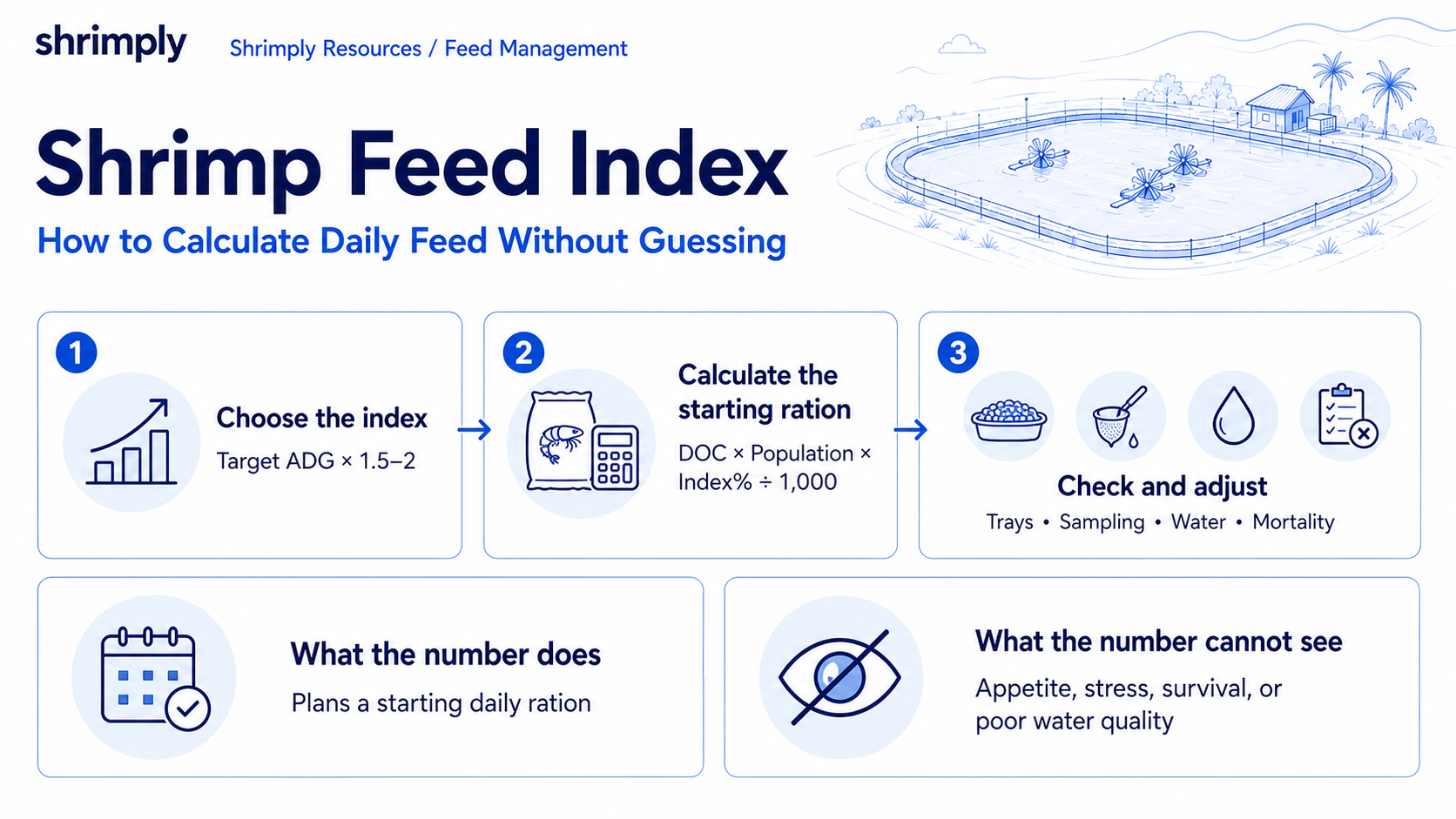
Feed index is a planning method used to estimate how much feed a shrimp pond should receive each day. It uses the shrimp's days of culture (DOC), population, and a chosen index linked to target average daily growth (ADG).
The result is only a starting ration. Feed trays, sampling, survival, mortality, partial harvests, and water quality must still guide the final amount.
Feed index formula
A commonly used formula is: daily feed (kg) = DOC × shrimp population × (feed index ÷ 100) ÷ 1,000.
For example, a pond at DOC 30 with 100,000 stocked shrimp and a feed index of 0.40 gives: 30 × 100,000 × 0.004 ÷ 1,000 = 12 kg/day.
The starting feed allocation is therefore 12 kg per day, divided across the farm's feeding schedule.
How to choose the feed index
Some farms begin with an index around 1.5 to 2 times the target ADG. For example, a target ADG of 0.20 g/day may lead to a starting index between 0.30 and 0.40.
This is a farm-planning convention, not a universal biological rule. The correct index depends on shrimp size, feed quality, stocking density, survival, pond conditions, feeding method, and past farm performance.
Feed index, feed rate, and FCR are different
Feed index looks forward. FCR looks backward. Neither number should be judged alone.
Scroll sideways to see all columns.
| Measure | Main purpose | When it is used |
|---|---|---|
| Feed index | Plans daily feed from DOC, population, and target growth | Before feeding |
| Feed rate | Calculates feed as a percentage of estimated biomass | After reliable sampling |
| FCR | Compares feed used with biomass gained | During review or after harvest |
Why the calculation can become wrong
The formula may overestimate feed when it continues using the original stocking number after mortality or partial harvest. It may underestimate feed when growth is stronger than expected or when the selected index is too low.
Sampling error can also distort the decision. A sample containing mostly large, active shrimp may overstate mean body weight and biomass.
FAO guidance stresses that feeding plans should respond to shrimp size, estimated survival, water conditions, and observed feeding behaviour—not remain fixed throughout the cycle.
How to adjust the ration safely
Feed management must keep changing as shrimp grow and pond conditions move.
- Check several feed trays: One empty or full tray is not enough to judge the whole pond.
- Review recent sampling: Compare MBW and ADG with the target used to choose the index.
- Correct the population estimate: Include recorded mortality and every partial harvest.
- Check water quality: Review dissolved oxygen, temperature, pH, ammonia, and nitrite before increasing feed.
- Make gradual changes: Avoid a large ration increase based on one good tray check.
- Confirm the result: Watch the next tray checks, water readings, mortality pattern, and sampling result.
Warning signs that the feed index needs review
Possible over-allocation signs include feed remaining repeatedly across several trays, FCR rising while ADG stays flat, feed use increasing faster than biomass, weakening early-morning dissolved oxygen, or rising ammonia, nitrite, sludge, or organic waste.
Possible under-allocation signs include trays clearing unusually quickly across repeated checks, ADG remaining below target without clear water-quality or health stress, poor feed distribution, or a higher actual population or biomass than the working estimate.
These are warning signs, not proof. Check the full pond record before changing the ration.
Use Shrimply to review the feed index
Record actual feeding in Feed History. Use Sampling to compare MBW and ADG with the growth target. Record mortality and partial harvests so the population estimate stays realistic.
Compare feeding changes with Water Quality trends, and reconcile feed use with Inventory before trusting FCR. Sampling records should track growth but must not deduct feed inventory; only actual feeding should reduce feed stock.
For a biomass-percentage method rather than a DOC index curve, use the Vannamei Feeding Rate Chart & Calculator as a starting baseline.
When to get specialist help
Escalate when feed response remains weak, mortality continues, shrimp show abnormal behaviour, water conditions remain unstable, or growth falls despite reliable feed and sampling records. Do not diagnose disease from tray results or slow growth alone.
What to apply on the farm
- Calculate the index ration from DOC, population, and the farm's chosen index.
- Treat the answer as a starting amount, not an automatic feeding instruction.
- Check several trays and review recent MBW, ADG, mortality, harvest, and water-quality records.
- Adjust the population estimate after reliable evidence of mortality or partial harvest.
- Change the ration gradually and confirm the response before changing it again.
How do I calculate the shrimp feed index ration?
A commonly used formula is: daily feed in kg = DOC × shrimp population × (feed index ÷ 100) ÷ 1,000. Treat the answer as a starting ration and adjust it using real pond observations.
Is feed index the same as FCR?
No. Feed index plans a daily ration before feeding, while FCR compares feed already used with biomass already gained.
Aquaculture engineers and vannamei shrimp farm practitioners dedicated to precision pond data, evidence-based water quality management, and biological yield optimization.
M.Sc. in Aquatic Animal Nutrition, 14+ years commercial vannamei feed formulation and feeding rate optimization
Shrimp feed management software
Explore how shrimp feed management software connects with this farm guide in Shrimply.
Improving FCR in Shrimp Farming: How to Use Feed Conversion Ratio Correctly
Understand shrimp feed conversion ratio, why FCR matters, what can distort it, and how farms can improve FCR with better feed, biomass, mortality, and harvest records.
Vannamei Feeding Rate Chart & Calculator: Daily Feed by Body Weight
Estimate a baseline daily ration for Pacific white shrimp from standing biomass and average body weight, then adjust it using feed trays, recent sampling, harvests, and water quality.
Shrimp farming resources library
Browse more practical Shrimply guides for vannamei farm operations and management.