Why record keeping changes farm decisions
Farm records help managers learn from each pond instead of relying on memory. The FAO record-keeping guidance for aquaculture highlights feed distribution, water quality, production, and stock records as tools for commercial management.
For shrimp farms, the highest-value records are usually feed use, feed stock, water quality, sampling, mortality, treatments, harvest, and costs. These records become more powerful when they are tied to the same pond and cycle.
Daily records
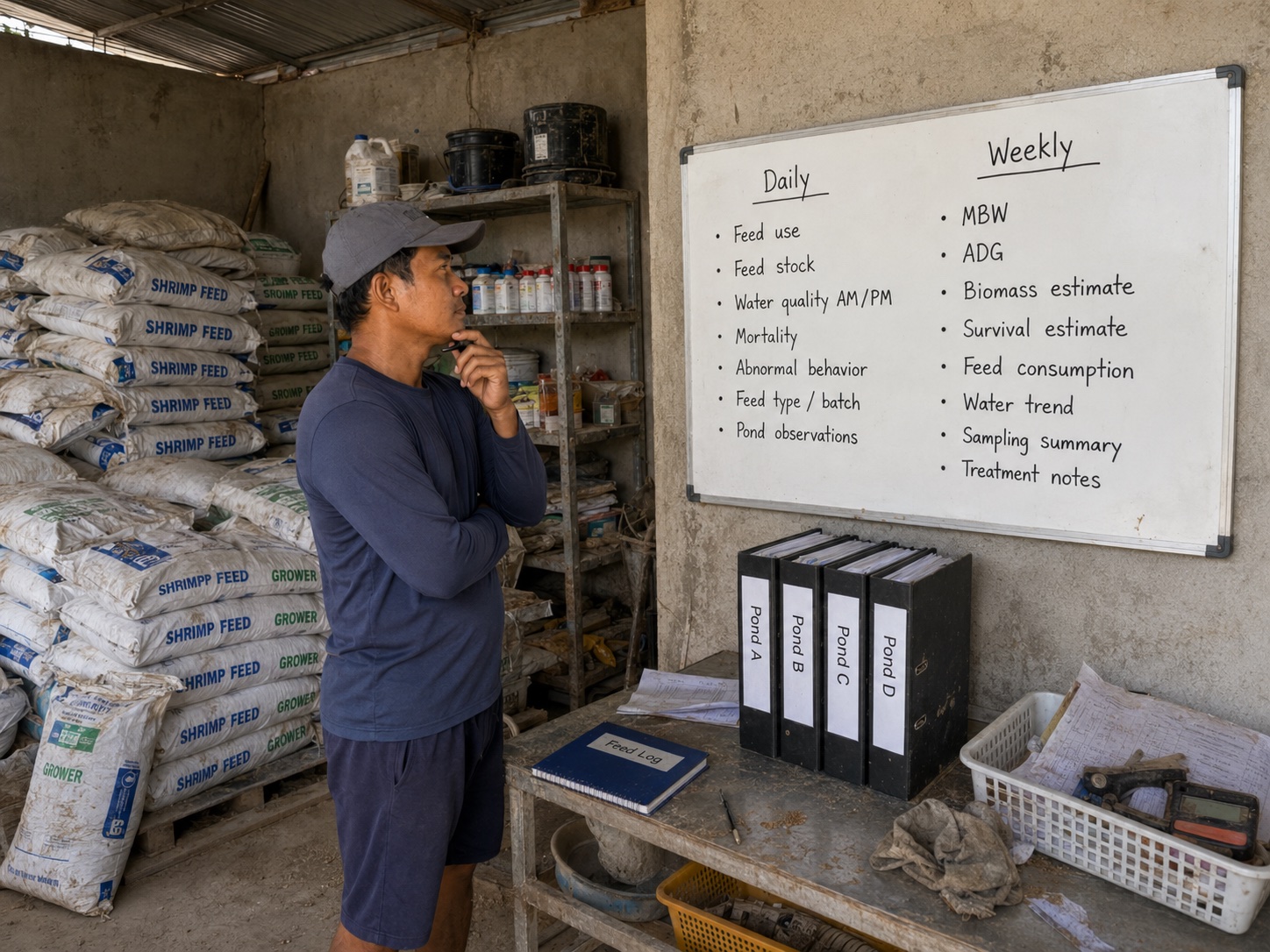
Daily records should answer: what was fed, what was observed, what changed in water quality, and whether mortality or abnormal behavior appeared. Feed records should also identify feed type or batch where possible, because poor feed quality or inconsistent handling can affect results.
Water records should include time of measurement because readings such as dissolved oxygen and pH move through the day. A morning reading and an afternoon reading can tell different stories.
Weekly and cycle records
Weekly records should summarize MBW, ADG, biomass estimate, survival estimate, feed consumption, and water trend. Cycle records should include stocking, harvest, cost, revenue, feed total, treatments, and final notes on what changed.
What to apply on the farm
- Track daily feed, water quality, mortality, and unusual observations.
- Record feed type, feed movement, and stock balance.
- Keep sampling and harvest data connected to the same pond cycle.
- Review records weekly while there is still time to act.
What is shrimp farm record keeping?
Farm records help managers learn from each pond instead of relying on memory. The FAO record-keeping guidance for aquaculture highlights feed distribution, water quality, production, and stock records as tools for commercial management. Farm records are management tools, not paperwork.
Why does record keeping matter for shrimp farmers?
Farm records are management tools, not paperwork. Daily logs should capture feed, water quality, mortality, and unusual pond observations. Cycle records should connect biological results to cost and harvest outcomes.
What should farmers review when managing record keeping?
Track daily feed, water quality, mortality, and unusual observations. Record feed type, feed movement, and stock balance. Keep sampling and harvest data connected to the same pond cycle. Review records weekly while there is still time to act.
Aquaculture engineers and vannamei shrimp farm practitioners dedicated to precision pond data, evidence-based water quality management, and biological yield optimization.
M.M. in Agribusiness, 15+ years commercial shrimp farm production planning, cycle cost modeling, and harvest operations
Shrimp farm management software
Explore how shrimp farm management software connects with this farm guide in Shrimply.
Pond Performance: The Shrimp Farm Scorecard That Actually Matters
Learn how shrimp farmers can read pond performance using stocking, survival, feed use, water quality, sampling, harvest, and cost records.
Vannamei Stocking Density per m²: Complete Guide & Calculator
Calculate Pacific white shrimp stocking density per m², post-larvae (PL) count, required aeration horsepower, and carrying capacity with our interactive calculator and farm guide.
Shrimp farming resources library
Browse more practical Shrimply guides for vannamei farm operations and management.