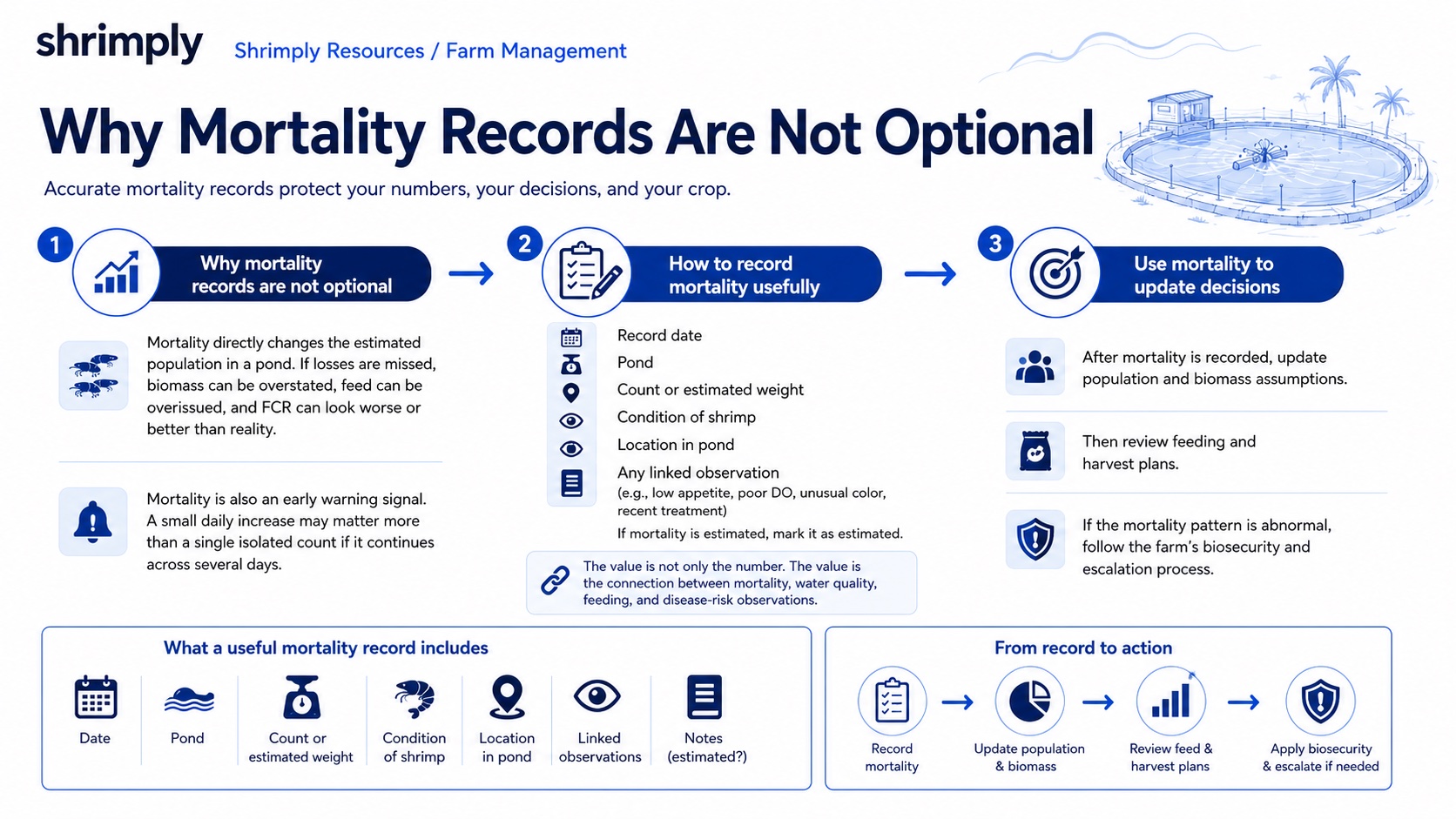
Why mortality records are not optional
Mortality directly changes the estimated population in a pond. If losses are missed, biomass can be overstated, feed can be overissued, and FCR can look worse or better than reality.
Mortality is also an early warning signal. A small daily increase may matter more than a single isolated count if it continues across several days.
How to record mortality usefully
Record date, pond, count or estimated weight, condition, location, and any linked observation such as low appetite, poor DO, unusual color, or recent treatment. If mortality is estimated, mark it as estimated.
The value is not only the number. The value is the connection between mortality, water quality, feeding, and disease-risk observations.
Use mortality to update decisions
After mortality is recorded, update population and biomass assumptions. Then review feeding and harvest plans. If the mortality pattern is abnormal, follow the farm's biosecurity and escalation process.
What to apply on the farm
- Record mortality daily by pond.
- Separate confirmed counts from estimates.
- Update population and biomass assumptions.
- Review mortality trends with water quality and appetite.
Why are shrimp dying in my pond?
Mortality can be associated with water-quality stress, disease, feed response, handling, predators, and other operational conditions. Record the timing, pond area, shrimp condition, appetite, water readings, and recent changes, then follow the farm's biosecurity and diagnostic escalation process.
How does shrimp mortality affect FCR and harvest planning?
Unrecorded losses overstate population and biomass, which can lead to overfeeding, misleading FCR, and unrealistic harvest expectations. Update population and biomass assumptions when a mortality pattern is confirmed.
Aquaculture engineers and vannamei shrimp farm practitioners dedicated to precision pond data, evidence-based water quality management, and biological yield optimization.
Ph.D. in Aquaculture Engineering, 18+ years tropical penaeid farm advisory and biosecurity audit experience
Shrimp farming resources library
Browse more Shrimply guides for feed, water quality, growth, disease, harvest, and finance workflows.
Vannamei Water Quality Parameters: Target Ranges & Warning Signs
Practical water quality reference for Pacific white shrimp (Litopenaeus vannamei), with contextual ranges for dissolved oxygen, temperature, pH, salinity, alkalinity, ammonia, nitrite, and nitrate.
Shrimp Pond Water Colour: Algae Types, Risks and Solutions
Learn what green, brown, blue-green, red, clear, or dark shrimp-pond water may indicate and how to monitor and manage algae safely.